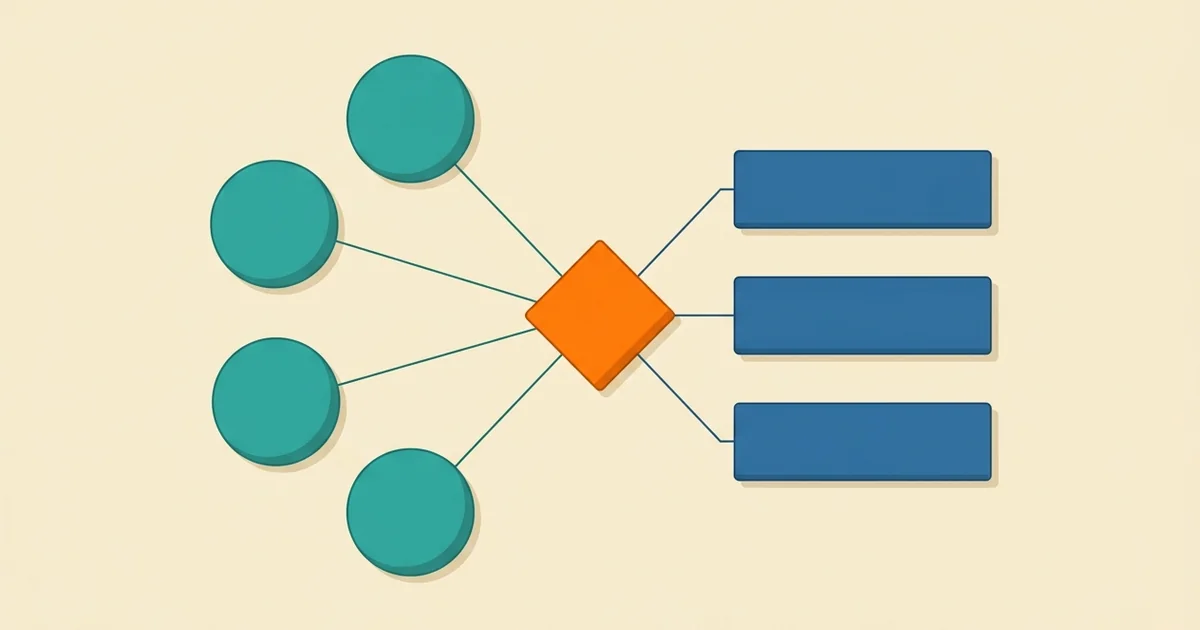
A conceptual framework defines the relevant concepts, proposed relationships, assumptions, and boundaries of a study. It may be expressed in prose or supported by a diagram, and may adopt or adapt existing work with attribution; the terminology and requirements vary by field.
How to build a conceptual framework for an academic paper
Your topic makes sense in your head, but the moment you try to draw the framework, everything turns into floating boxes, vague arrows, and words like “influence” or “impact” that do more hiding than explaining. You may know the literature, have a research question, and even understand your method, yet still feel unsure about how to build a conceptual framework that looks like academic reasoning rather than a decorative diagram. The problem is usually not drawing skill. It is that the concepts, relationships, assumptions, and boundaries have not been made explicit enough before the diagram begins.
Build a conceptual framework by defining the relevant concepts, justifying the proposed relationships and assumptions, and explaining the study’s boundaries. A diagram can help, but is not compulsory unless required. You may adopt or adapt an established framework with attribution and any applicable reuse conditions; a useful framework need not be newly invented.
In this guide
- What is a conceptual framework in research?
- How do you build a conceptual framework from a topic?
- How do you choose the key concepts for a conceptual framework?
- How do you show relationships between concepts?
- How do you draw a conceptual framework diagram?
- What does a conceptual framework example look like in different subjects?
- What is the difference between a theoretical framework and a conceptual framework?
- What mistakes do students commonly make when building a conceptual framework?
- How can you check whether your conceptual framework is ready to use?
What is a conceptual framework in research?
A conceptual framework in research is a structured explanation of the main concepts in your paper and the relationships between them. It shows what your study or argument focuses on, what it excludes, and how the literature supports the connections you plan to examine. For undergraduate and master’s papers, it often appears as a short written section plus a diagram.
Core definition
Concept means a key idea your paper uses, such as “student engagement,” “nurse burnout,” “brand trust,” or “perceived risk.” A concept is not just a topic word; it needs a working definition that fits your paper.
Relationship means the connection you propose between concepts. In empirical work, this may be an expected association, influence, difference, or process. In theoretical or conceptual work, it may be a logical connection, tension, category, or explanatory link.
Here, “conceptual framework” means an organized account of the concepts and relationships relevant to this paper. Terminology and uses vary across disciplines and inductive or deductive approaches. State how your course or field uses the term rather than treat the distinction from a theoretical framework as universal.
For example, a business student writing about online customer reviews might connect “review credibility,” “consumer trust,” and “purchase intention.” The framework would explain how credibility may affect trust and how trust may shape intention, with clear boundaries around the platform, product type, and consumer group.
What the framework does in a paper
A conceptual framework helps the reader understand why your paper includes certain ideas and ignores others. It gives structure to the literature review, because sources can be discussed according to the concepts and links in the framework rather than in random order.
It also protects the paper from drifting. If your research question asks about how feedback affects first-year student motivation, your framework should not suddenly expand into every possible theory of learning. The framework keeps the paper aligned with its actual task.
If you are still turning an assignment brief into a workable structure, it may help to first convert the requirements into a plan. Texio’s article on assignment brief requirements turning into a paper plan shows how to separate topic, task, scope, and output before you build the framework.
Framework, outline, and argument are related but not identical
A conceptual framework is not the same as a chapter outline. An outline tells the reader the order of sections. A framework tells the reader the logic behind the concepts in those sections.
A framework is also not the same as your full argument. The argument is what you claim after analysis. The framework is the structure that makes the analysis possible.
Think of a seminar paper on social media use and anxiety among undergraduate students. The outline might include introduction, literature review, method, results, and discussion. The conceptual framework would define “social media use,” “social comparison,” and “anxiety symptoms,” then explain the proposed relationship between them.
How do you build a conceptual framework from a topic?
Start with the topic, narrow it into a research problem, turn that problem into a research question, and then identify the concepts needed to answer that question. Developing a conceptual framework works best when you move from broad subject area to specific conceptual relationships. The diagram comes after the logic is clear, not before.
Step-by-step process
Use this sequence before opening any diagram tool:
- Write your topic in one sentence.
- Identify the specific problem, tension, or gap within that topic.
- Draft one research question that can be answered within your paper length.
- List the main concepts named or implied in the question.
- Define each concept using academic sources.
- Decide what kind of relationship connects the concepts.
- Set the boundaries: population, setting, time period, texts, sector, or context.
- Create a simple diagram showing only the concepts and relationships you need.
- Check whether every box and arrow can be explained in the written section.
Use only the concepts and relationships that have justified roles in this paper, including important context or alternative explanations. Word count and degree do not determine a universal number of concepts, and a framework should not be simplified merely to fit a numerical rule.
From topic to framework logic
Here is a realistic before-and-after example:
| Student version | Stronger rewrite |
|---|---|
| “My topic is remote work and productivity.” | “This paper examines how perceived autonomy and communication quality relate to self-reported productivity among early-career employees working remotely.” |
| “Social media affects mental health.” | “This paper examines whether upward social comparison helps explain the relationship between Instagram use and anxiety symptoms among undergraduate students.” |
| “Nurses are stressed.” | “This paper analyses how workload intensity and supervisor support relate to burnout risk among nurses in acute care settings.” |
| “Technology improves learning.” | “This paper explores how perceived usefulness and digital confidence shape student engagement with a university learning platform.” |
The stronger versions work because they name the concepts and suggest a relationship. “Remote work” becomes more precise through “perceived autonomy,” “communication quality,” and “self-reported productivity.” Those concepts can become framework boxes.
Connecting to the research question
A framework built from a weak research question will usually stay weak. If the question is “How does social media affect students?”, the framework has no clear limit. Which platform? Which students? Which outcome?
A better question might be: “How does upward social comparison on Instagram relate to anxiety symptoms among undergraduate psychology students?” Now the framework has a clear shape: Instagram use may increase upward comparison, and upward comparison may relate to anxiety symptoms.
For more help at this earlier stage, see Texio’s article on a funnel narrowing broad ideas into one research question. A focused question gives your framework a clear centre of gravity.
How do you choose the key concepts for a conceptual framework?
Choose key concepts by asking which ideas are necessary to answer your research question and which ideas are directly supported by the literature. A concept belongs in the framework only if it has a defined role in your analysis, not simply because it appeared in a source. Fewer well-defined concepts usually work better than many vague ones.
Inclusion test for concepts
Use these questions to decide whether a concept deserves a place in your framework:
- Does the concept appear in the research question, aim, objective, or hypothesis?
- Can you define it in one or two precise sentences?
- Can you link it to credible academic sources?
- Does it connect to at least one other concept in the framework?
- Will you discuss, measure, compare, or apply it in the body of the paper?
- Is it within the paper’s scope and word count?
If the answer is “no” to several of these, the concept may belong in the background section rather than the framework.
Concept types in quantitative, qualitative, and theoretical papers
In quantitative work, concepts may be operationalized as variables. Predictor and outcome roles apply to some models; descriptive or symmetric association studies need not force those roles. A mediator represents a proposed intervening pathway, whereas a moderator represents variation in a relationship across conditions. A diagram or fitted model alone establishes neither a causal pathway nor its assumptions.
For example, a psychology paper may examine whether sleep quality predicts academic concentration, with stress level acting as a mediator. If you need to define measurable variables more carefully, Texio’s article on defining quantitative variables is a useful next step.
In qualitative empirical research, concepts often work as sensitising ideas rather than measurable variables. A nursing paper on medication adherence after hospital discharge might use “patient understanding,” “family support,” and “care transition communication” as concepts that guide interview questions and coding.
In theoretical or conceptual work, concepts may be categories, principles, mechanisms, or tensions. A law paper might examine “procedural fairness,” “administrative discretion,” and “access to remedy” to build an argument about decision-making standards.
Weak versus stronger concept selection
Weak: “The framework includes technology, students, education, motivation, satisfaction, learning, teachers, and performance.”
Stronger: “The framework focuses on perceived usefulness, digital confidence, and student engagement because these concepts directly connect to the research question about learning platform use among first-year university students.”
The stronger version does not try to include every related idea. It selects concepts based on the paper’s question and makes the relationship easier to defend.
How do you show relationships between concepts?
Show relationships by naming the type of connection between concepts and explaining why the literature supports that connection. An arrow in a conceptual framework diagram is not enough on its own. Each relationship needs a short written justification that states what moves, changes, explains, shapes, or depends on what.
Common relationship types
Different papers need different relationship language. Here are common options:
- Association: two concepts tend to vary together, without claiming direct cause.
- Influence: one concept is expected to shape another.
- Prediction: one variable is used to estimate or explain an outcome.
- Mediation: one concept explains the pathway between two other concepts.
- Moderation: one concept changes how strongly two other concepts relate.
- Comparison: two groups, cases, texts, or contexts are compared through shared concepts.
- Process: concepts occur in a sequence, such as awareness, evaluation, decision, and action.
- Tension: two concepts conflict or pull the argument in different directions.
Avoid using the same arrow style for every type of link if the relationships differ. A paper that contains mediation and moderation needs words in the written explanation that separate those roles, even if the diagram stays simple.
Relationship statements
A useful relationship statement has three parts: concept A, relationship type, and concept B. It also names the context.
For example:
- “Perceived supervisor support may reduce burnout risk among acute care nurses by improving perceived coping capacity.”
- “Upward social comparison may mediate the relationship between Instagram use and anxiety symptoms among undergraduate psychology students.”
- “Perceived usefulness and digital confidence may jointly shape engagement with a university learning platform.”
- “Procedural fairness may constrain administrative discretion when public authorities make eligibility decisions.”
The examples throughout this guide are invented teaching models, not verified findings or ready-to-use clinical, psychological, or legal frameworks. They illustrate possible claims that would need appropriate sources and evidence. Calling a link an “influence” or using “may” does not by itself justify a causal interpretation.
Matching relationship claims to evidence
Match claims to the design, evidence, and assumptions. In a cross-sectional survey, “associated with” can describe a numerical pattern; “predicts” should specify whether it refers to model prediction rather than a future or causal effect. Mediation coefficients do not by themselves identify a causal mechanism. Mark untested pathways as hypotheses, and evaluate plausible alternative explanations.
A conceptual framework in research is not just a picture of your personal assumptions. It is a reasoned model built from sources, definitions, and scope. If the literature is mixed, the framework can show uncertainty by using cautious language in the written explanation.
How do you draw a conceptual framework diagram?
Draw a conceptual framework diagram by placing the main concepts in boxes or nodes, connecting them with arrows or lines, and keeping the layout simple enough to explain in one paragraph. The best diagram is not the most artistic one. It is the one that lets the reader understand the paper’s logic quickly.
Basic diagram structure
Most student frameworks use one of these patterns:
| Framework pattern | Best for | Concrete example |
|---|---|---|
| Linear relationship | One main predictor and one outcome | “Digital confidence → student engagement” |
| Multiple predictors | Several concepts linked to one outcome | “Workload intensity + supervisor support → burnout risk” |
| Mediation model | A pathway through an explanatory concept | “Instagram use → upward comparison → anxiety symptoms” |
| Moderation model | A condition changes a relationship | “Autonomy → productivity, moderated by communication quality” |
| Comparative model | Same concepts applied to cases or groups | “Procedural fairness in university appeals vs housing benefit appeals” |
Choose the pattern that matches your research question. Do not force a mediation model into a short paper if your sources only support a general association.
Diagram design rules
Keep the diagram readable:
- Use boxes for concepts and arrows for directional relationships.
- Use a solid arrow for the main relationship.
- Use a dashed line only if you explain what the dashed line means.
- Keep labels short: “burnout risk,” not a full sentence.
- Do not include every subtopic from the literature review.
- Align concepts so the flow is easy to follow.
- Explain the diagram immediately after presenting it.
If your paper uses variables, the diagram should match your hypotheses or objectives. If your paper is qualitative, the diagram can show sensitising concepts and expected areas of inquiry. If your paper is theoretical, it can show how concepts structure the argument.
Written explanation below the diagram
Never leave the diagram to speak for itself. After the figure, write a paragraph like this:
“The framework positions workload intensity and supervisor support as key concepts related to burnout risk among nurses in acute care settings. Workload intensity is expected to increase burnout risk, while supervisor support is expected to reduce it by improving coping resources and perceived organisational support. The framework limits the analysis to workplace factors and does not examine personal health history or broader staffing policy.”
That paragraph does three jobs: it defines the logic, explains the arrows, and states the boundary. Without it, the diagram may look clear to you but remain ambiguous to the reader.
What does a conceptual framework example look like in different subjects?
A conceptual framework example should fit the discipline, research type, and paper scope. The same basic model of concepts and relationships can look different in psychology, nursing, business, education, law, or management. What matters is that the framework matches the research question and can be supported by academic sources.
Social sciences and psychology example
Research question: “How does upward social comparison on Instagram relate to anxiety symptoms among undergraduate psychology students?”
Possible framework:
- Instagram use is the context of social media exposure.
- Upward social comparison is the explanatory concept.
- Anxiety symptoms are the outcome.
- Self-esteem may be included as a moderating concept if the literature supports it.
Relationship statement: “Instagram use may be associated with anxiety symptoms partly because repeated exposure to idealised peer images encourages upward social comparison.”
This framework works because it avoids treating “social media” as one huge concept. It identifies a platform, a mechanism, and an outcome. A literature review could then be organised around platform use, social comparison theory, and anxiety symptoms.
Health sciences and nursing example
Research question: “How do discharge communication and family support relate to medication adherence among older patients receiving home care?”
Possible framework:
- Discharge communication shapes patient understanding.
- Patient understanding affects medication adherence.
- Family support may strengthen adherence after discharge.
- Home care context sets the boundary.
Relationship statement: “Clear discharge communication may improve patient understanding of medication routines, while family support may help maintain adherence during the transition to home care.”
This nursing example shows that a conceptual framework does not always need a statistical model. If the paper is qualitative, the framework may guide interview questions about communication, understanding, support, and adherence. The findings can later refine the relationship between those concepts.
Education and business examples
In education, a paper might ask: “How does feedback timing influence student engagement in first-year online courses?” The framework could connect “feedback timing,” “perceived usefulness of feedback,” and “engagement behaviour.” If the paper includes interviews, these concepts can guide questions about how students interpret and act on feedback.
In business or management, a paper might ask: “How does remote work autonomy relate to self-reported productivity among early-career employees?” The framework could connect “work autonomy,” “communication quality,” and “self-reported productivity.” Communication quality might act as a moderator if poor communication weakens the benefit of autonomy.
These examples show why developing a conceptual framework is not a copy-paste exercise. The same diagram pattern can be used across disciplines, but the concepts and relationship claims must come from the paper’s own research problem.
What is the difference between a theoretical framework and a conceptual framework?
One useful working distinction is that a theoretical framework articulates the theories and assumptions informing a study, while a conceptual framework organizes its relevant concepts and relationships. These terms overlap in some disciplines and are used differently across research approaches. Follow the applicable convention and explain your use.
Theory versus paper-specific model
A theory is a broader explanatory system, such as social comparison theory, self-determination theory, planned behaviour theory, or institutional theory. A conceptual framework may use one theory, combine ideas from several theories, or adapt concepts from the literature to fit a specific research question.
For example, a psychology paper might use social comparison theory as the theoretical basis. Its conceptual framework would then apply that theory to Instagram use, upward comparison, and anxiety symptoms among a specific student group.
A management paper might use self-determination theory to discuss autonomy. Its conceptual framework would connect autonomy to productivity in remote work, perhaps adding communication quality as a condition.
When you need both
Some papers include both a theoretical framework and a conceptual framework. This is common in master’s research papers and capstone projects where the paper needs both a theory base and a study-specific model.
Other papers may need only a conceptual framework, especially shorter theoretical papers or seminar papers. If your assignment brief asks for a “framework” but does not specify which kind, check whether the expected output is a theory discussion, a concept map, or both.
Texio’s comparison of a theoretical and conceptual framework model comparison may help if you are unsure which section your paper needs. If your paper is mainly conceptual rather than empirical, the article on an argument synthesis map for a theoretical paper can also help you connect framework logic to argument structure.
How they work together in writing
The theoretical framework usually comes before the conceptual framework. You first explain the theory or theories, then show how your paper adapts them into a specific model.
For instance:
- Theoretical framework: social comparison theory explains how people evaluate themselves against others.
- Conceptual framework: Instagram exposure may encourage upward comparison, which may relate to anxiety symptoms among undergraduate students.
That sequence prevents a common problem: dropping theory names into a paper without showing how they shape the actual analysis.
What mistakes do students commonly make when building a conceptual framework?
Students often weaken a conceptual framework by adding too many concepts, using vague arrows, confusing theory with topic background, or drawing a diagram that the paper never uses. These mistakes make the framework look disconnected from the research question. The fix is to make every concept, arrow, and boundary serve a specific role.
Mistake patterns and corrections
-
The “everything related” framework
Student example: “The framework includes motivation, education, technology, students, teachers, society, performance, satisfaction, and success.”
Correction: Select only the concepts needed to answer the question. For a paper on learning platform engagement, “perceived usefulness,” “digital confidence,” and “student engagement” may be enough. -
The undefined concept box
Student example: “Motivation affects performance.”
Correction: Define the concept in context. Is motivation intrinsic motivation, exam motivation, career motivation, or perceived task value? Is performance measured by grades, completion, attendance, or self-report? -
The unsupported causal arrow
Student example: “Instagram causes anxiety in students.”
Correction: Match the claim to the design and evidence. A bounded framework may separate an observed association between Instagram use and anxiety symptoms from a hypothesized role for upward comparison. “Through” implies a pathway that requires additional justification. -
The theory-name dump
Student example: “This paper uses social learning theory, motivation theory, constructivism, and technology acceptance theory.”
Correction: Use fewer theories and explain their role. If technology acceptance theory is central, connect perceived usefulness and ease of use to the learning platform question. -
The diagram that does not appear in the paper again
Student example: The diagram includes “institutional policy,” but the literature review, method, and discussion never mention policy.
Correction: Remove the concept or add it properly to the analysis. Every diagram element should reappear in the written paper.
Why these mistakes happen
Most of these problems come from starting with the diagram too early. Diagram tools make it easy to add boxes before the logic is settled. The result may look organised, but it does not guide the paper.
Another cause is fear of leaving something out. Students often include extra concepts to show they have read widely. Academic writing usually rewards the opposite: controlled selection, clear definitions, and a framework that fits the assignment.
A quick repair method
If your framework already feels messy, try this:
- Circle the research question.
- Underline every concept named in that question.
- Cross out any diagram box that does not connect to those concepts.
- Rewrite each arrow as a sentence.
- Delete any arrow you cannot explain with sources.
- Add one boundary sentence that says what the framework excludes.
Use this repair process to clarify roles and unsupported connections, not to promise a usable model within an hour. Retain relevant confounders, context, and alternative explanations even when they are not named in the research question.
How can you check whether your conceptual framework is ready to use?
A conceptual framework is ready when the reader can identify the main concepts, understand the relationships, and see how the framework connects to the rest of the paper. It should be specific enough to guide the literature review, method, and analysis. If the diagram and written explanation do not match, revise before drafting further.
Alignment with the paper
Check the framework against four parts of the paper:
- Research question: Does the framework answer the exact question being asked?
- Literature review: Are the concept definitions and relationships supported by sources?
- Method: Can the concepts be studied through your chosen method?
- Discussion: Will the framework help interpret the findings or argument?
For empirical work, the framework should also connect to your methodology choice. A quantitative survey framework may need variables, indicators, and hypotheses. A qualitative interview framework may need concepts that guide question design and later coding. Texio’s article on research methodology choice as a five-stage decision flow can help you check whether your framework and method fit each other.
Before-and-after framework check
Use this side-by-side comparison to test your own draft:
| Weak framework element | Stronger framework element |
|---|---|
| “Technology” | “Perceived usefulness of the university learning platform” |
| “Students are affected” | “First-year undergraduate students’ engagement with weekly online activities” |
| “Communication influences outcomes” | “Discharge communication may improve medication understanding, which may support adherence” |
| “Theory: motivation” | “Self-determination theory informs the role of autonomy in remote work productivity” |
| “Many factors affect anxiety” | “Upward social comparison may explain part of the relationship between Instagram use and anxiety symptoms” |
The stronger elements are not longer for the sake of length. They are more usable because they name the concept, context, and relationship.
Before you move on: conceptual framework checklist
- The research question is narrow enough to support a specific framework.
- Every concept in the diagram has a written definition.
- Each relationship is explained in a sentence, not only shown with an arrow.
- The framework uses cautious language where causality is not proven.
- The diagram contains only concepts used later in the paper.
- The literature review can be organised around the framework’s concepts.
- The method matches the kind of concepts being studied.
- Boundaries such as population, setting, sector, or text type are stated.
- The theoretical basis, if used, is connected to the paper-specific model.
- The diagram is simple enough to understand without a long explanation.
- The framework fits the word count and degree level of the assignment.
Final quality test
Ask a peer to look at the diagram for thirty seconds, then explain what the paper is about. If they can name the main concepts and the expected relationship, the framework is probably clear. If they only say “it is about students and technology” or “it is about health care,” the framework is still too broad.
Then test the written explanation. Every sentence should either define a concept, explain a relationship, justify a boundary, or connect the framework to the research question. If a sentence does none of those things, it may belong somewhere else.
For further guidance, see Varpio and colleagues: framework terminology and USC: theoretical frameworks and assumptions. These resources offer research and writing guidance; they do not validate the examples in this guide or replace assignment requirements.
Frequently Asked Questions
How long should a conceptual framework be in an undergraduate or master’s paper?
There is no universal word count for a conceptual framework. Follow the assignment or publication instructions, and provide the definitions, rationale, assumptions, and boundaries needed to understand its role. A diagram is optional unless required and must be explained if used.
How many concepts should a conceptual framework include?
There is no universal three-to-six-concept rule. Include the concepts needed for the inquiry and justify their roles. Consider complexity, assumptions, evidence, and the required scope rather than remove an important variable or competing explanation to meet a fixed count.
What is the difference between a conceptual framework and a literature review?
A conceptual framework shows the model of concepts and relationships that structures your paper. A literature review discusses the sources that define, support, challenge, or refine those concepts. The framework gives the literature review an organising logic, but it does not replace source analysis.
Can a conceptual framework be used in qualitative research?
Yes, where appropriate to the approach. A qualitative framework may offer sensitizing concepts, guide deductive analysis, or develop during inductive analysis. Explain its actual role and remain open to contradictory material or concepts that emerge from the inquiry rather than force data into predetermined boxes.
Does every academic paper need a conceptual framework diagram?
No, not every paper requires a diagram. Some shorter theoretical or seminar papers may explain the framework in prose. If your assignment asks for a framework section, a simple diagram often helps, but only when the diagram is directly explained and used in the paper.