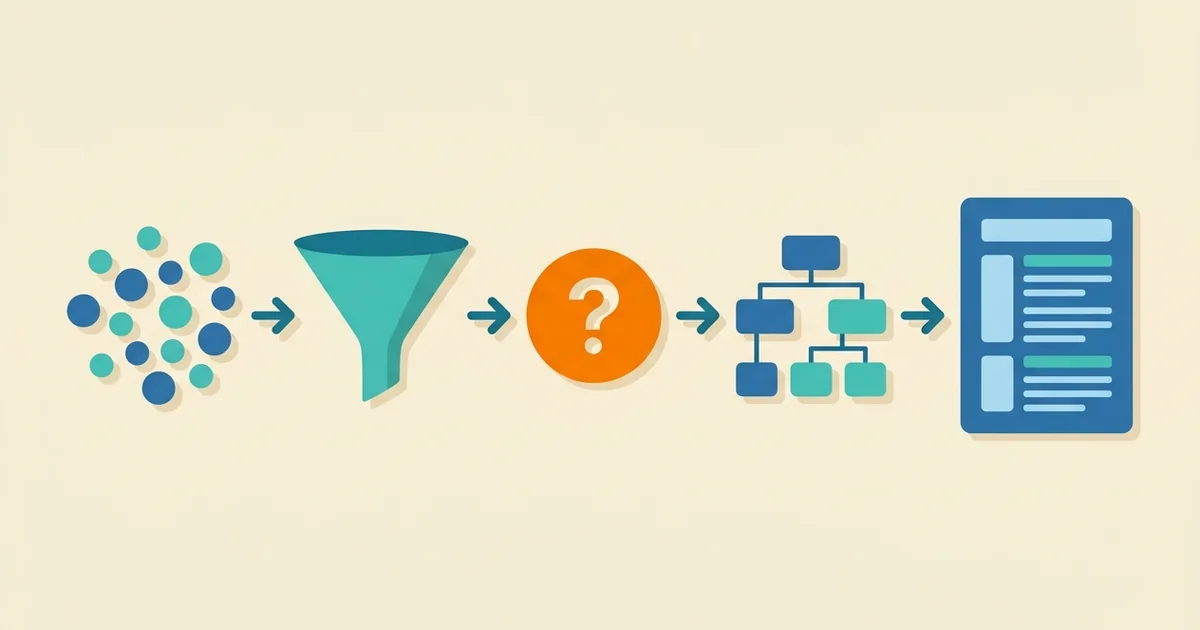
To narrow a research topic, move from a broad area to a specific research problem by limiting population, place, time period, variables, concepts, method, and available evidence. A focused topic is answerable within your word count and supported by enough credible academic sources.
How to narrow a research topic without losing your argument
You know how to narrow a research topic in theory, but your tutor’s comment still says “too broad,” “unclear focus,” or “not feasible for this assignment.” The problem is rarely that your idea is bad. More often, the topic is trying to do too many jobs at once: explain a whole field, compare several groups, cover a long time period, and answer a question no single undergraduate or master’s paper can reasonably handle. That is when a promising idea turns into a vague introduction, a scattered literature review, and an outline that keeps expanding instead of getting sharper.
To narrow a research topic, turn a broad area into a specific research problem by setting limits on who, where, when, what relationship, and what evidence you will use. The goal is not to make the paper small; it is to make it answerable within your assignment length, method, and source base.
In this guide
- How do you narrow a research topic when your idea is too broad?
- What is the difference between a broad topic and a research problem?
- Which narrowing strategies work for undergraduate and master's papers?
- How do you control research scope before drafting?
- How can a broad topic become a focused research question?
- What mistakes do students commonly make when narrowing a research topic?
- How do examples from different disciplines show narrowing in practice?
- How do you know your narrowed topic is ready for an outline?
How do you narrow a research topic when your idea is too broad?
First check the prompt: narrow within its permitted scope, and obtain approval before changing an assigned question or excluding required material. In an open assignment, choose boundaries relevant to the problem and feasible evidence. Population, case, text, period, concepts, or method are possible filters, not a checklist every paper must complete.
Start with the pressure points
A broad topic usually feels broad because it contains too many possible papers. “Social media and mental health” could become a psychology survey, a media studies essay, a public health review, or a business ethics paper. Before choosing sources, ask which part of the topic creates the academic pressure: a disagreement, a gap in evidence, a practical problem, or a concept that is being used unclearly.
Useful first questions include:
- Who is affected?
- Which setting matters?
- What relationship or process is being examined?
- Which time frame changes the issue?
- What type of evidence is realistic for the assignment?
Research topic — the general subject area you want to study, such as “remote work” or “student anxiety.”
Research problem — the specific issue, gap, tension, or unanswered question within that topic.
Use boundaries before you search too widely
Use an initial boundary draft to make searching purposeful, then revise it as preliminary reading reveals terminology, evidence, and alternatives. Searching and narrowing are iterative; there is no need to finalize the scope before consulting literature. One possible starting sentence is:
“I am studying [specific group] in [setting] during [time period] to understand [relationship/problem] using [type of evidence].”
For example, “I am studying first-year university students in online introductory psychology courses after 2020 to understand how perceived instructor presence relates to academic confidence using peer-reviewed empirical studies.”
This sentence is not final. It works as a filter. If a source does not fit the sentence, it is probably background rather than core evidence.
Narrow without making the topic trivial
Narrowing research scope does not mean choosing a tiny or obvious issue. “The effects of sleep on students” is too broad; “sleep habits of one student in one week” is too narrow for most academic papers. The middle ground is a problem with a clear academic conversation around it, such as “the relationship between sleep quality and academic self-efficacy among first-year undergraduates.”
A focused topic gives you enough room to analyse causes, evidence, limitations, and implications. If you can answer the question in one paragraph, it is probably too narrow. If you need a book-length project to answer it, it is too broad.
What is the difference between a broad topic and a research problem?
A broad topic names an area; a research problem identifies a specific issue inside that area that can be examined. “Nursing communication” is a topic, while “how discharge communication affects medication adherence among older adults receiving home care” is a research problem. The research problem gives the paper a reason to exist.
Broad topic vs focused research problem
The shift from broad topic to research problem is the main move in academic planning. A topic says what interests you. A problem says what needs to be explained, tested, compared, interpreted, or clarified.
| Broad student idea | Focused research problem | Why the second version works |
|---|---|---|
| Social media and anxiety | The relationship between TikTok use and social anxiety symptoms among first-year undergraduates | Defines platform, outcome, and population |
| Nurse burnout | Barriers to reporting burnout among newly qualified nurses in acute care settings | Moves from a general issue to a specific practice problem |
| Online learning | How asynchronous feedback affects engagement in undergraduate business courses | Names a teaching practice, outcome, and context |
| Climate change law | How municipal zoning policies address flood-risk adaptation in coastal cities | Limits legal area, policy type, and setting |
| Motivation and grades | Whether academic self-efficacy predicts assignment completion among master’s students in online courses | Defines a measurable relationship |
These examples show that the narrower version does not merely add detail. It creates a paper that can make a claim.
The role of the research gap
A research gap is an unresolved area in the existing literature, such as an under-studied population, an inconsistent finding, a missing comparison, or a concept that needs clearer application. Narrowing works best when it responds to a gap rather than personal preference alone.
For instance, a student interested in workplace stress might find plenty of general research but less work on hybrid onboarding for early-career employees in small firms. That gap can become the focus. If you need a separate process for locating gaps, the article on source clusters revealing a research gap offers a useful companion method.
Weak and stronger versions
A weak narrowed topic often sounds specific but still lacks an academic problem. A stronger version names the relationship, population, and evidence base.
| Weak student version | Stronger rewrite |
|---|---|
| “I want to write about how social media is bad for students.” | “This paper examines how passive Instagram use is associated with perceived social comparison among undergraduate students.” |
| “My topic is nurse communication and patient safety.” | “This paper investigates how discharge communication practices affect medication adherence among older adults receiving home care.” |
| “I will study leadership in companies.” | “This paper analyses how transformational leadership is linked to employee retention intentions in small technology firms.” |
Notice that the stronger versions are not longer for the sake of sounding academic. They are more controlled.
Which narrowing strategies work for undergraduate and master's papers?
The most reliable strategies are narrowing by population, setting, time period, variable, concept, theory, method, and source base. Undergraduate papers often need sharper limits because the word count is shorter, while master’s papers can usually handle more theory or method detail. The right strategy depends on your assignment type and available evidence.
Narrow by population and setting
Population limits answer “who?” and setting limits answer “where?” Together, they stop a topic from drifting across unrelated contexts.
A psychology student might move from “stress and academic performance” to “perceived stress and assignment avoidance among first-year psychology students.” A nursing student might move from “patient education” to “discharge education for older adults prescribed multiple medications after hospitalisation.” A business student might move from “employee motivation” to “recognition practices among part-time retail workers.”
These versions are still broad enough for literature, but they no longer invite every possible angle.
Narrow by time period or change event
A time boundary is useful when a field has changed quickly. Online learning before 2020 differs from online learning during emergency remote teaching and from planned hybrid learning after campuses reopened. A paper that ignores this shift may mix evidence that does not belong together.
Time limits can be framed as:
- “after the introduction of a policy”
- “during the first year of study”
- “in post-pandemic hybrid courses”
- “between two legal reforms”
- “within the first six months after discharge”
A time boundary also protects your literature review from becoming a history of the entire field.
Narrow by relationship or mechanism
Many topics become clearer when you define the relationship you want to examine. Instead of “student motivation,” ask whether self-efficacy relates to persistence, whether feedback timing affects engagement, or whether peer support reduces withdrawal intentions.
For quantitative work, define the measures and comparisons or associations of interest. Some designs use predictor and outcome roles; symmetric correlations and descriptive studies need not force independent/dependent labels. For operational definitions, the article on defining quantitative variables can help.
For qualitative empirical work, the relationship may be less causal and more interpretive: how students describe belonging, how nurses experience role conflict, or how managers make sense of remote supervision.
Narrow by theory or lens
A theoretical lens helps you decide what counts as relevant. For example, “employee retention” can be narrowed through social exchange theory, job demands-resources theory, or organisational commitment theory. Each lens changes which concepts you include and which evidence matters.
In law, a student examining privacy and workplace monitoring might use a rights-based lens, a regulatory compliance lens, or a proportionality analysis. The same topic becomes a different paper depending on the framework.
A lens is useful only if it does real work. Do not add a theory name because it sounds advanced. Use it to define terms, select evidence, and shape the argument.
How do you control research scope before drafting?
You control scope by setting inclusion and exclusion rules before the outline grows. Decide what belongs in the paper, what counts only as background, and what must be left out even if it is interesting. Scope control protects the literature review, method section, and argument from expanding beyond the assignment.
Use the “include, exclude, background” test
Create three columns before drafting. In the first, list what your paper will directly analyse. In the second, list tempting material you will not cover. In the third, list context you may mention briefly.
For a paper on “asynchronous feedback and student engagement in undergraduate business courses,” the columns might look like this:
- Include: asynchronous written feedback, undergraduate business courses, engagement, peer-reviewed higher education studies.
- Exclude: primary school teaching, synchronous live feedback, general student satisfaction, non-academic training.
- Background: online learning growth, definitions of engagement, feedback theory.
This simple test prevents “scope creep,” where new sections appear because sources mention them.
Match scope to word count
Match scope to the actual question, analytical depth, evidence, format, and word limit. Neither a particular word count nor degree label determines a permissible number of variables, countries, or theories. A bounded comparison may be workable where a broad explanation of the same cases is not.
A rough planning rule:
- Use the introduction to define the problem and boundaries.
- Use the literature review to organise only the sources that directly support the problem.
- Use the analysis or discussion to answer one main question, not several loosely related questions.
- Explain deliberate scope choices as delimitations; discuss limitations that affect interpretation, including consequences of practical constraints.
If your outline needs more main sections than your word count can support, the topic is still too wide.
Build a source filter
Before saving every relevant-looking PDF, write your source filter in one sentence:
“A core source must address [population/setting], [main concept or variable], and [method or evidence type].”
For a literature review, you can then group sources thematically rather than chronologically. The article on thematic source clusters with a visible research gap is useful once your source base is focused enough to organise.
A source filter also helps you justify exclusions. You are not ignoring material randomly; you are keeping the paper aligned with its research problem.
How can a broad topic become a focused research question?
A broad topic becomes a focused research question when you convert interest into an answerable question about a specific problem, population, context, and evidence base. The question must fit the assignment’s method: empirical, theoretical, conceptual, or literature-based. If the question still contains several hidden questions, narrow it again.
A practical narrowing sequence
Use this sequence when your idea feels too open:
- Write the broad topic in five words or fewer.
- Add the population or case you care about.
- Add the setting or context.
- Choose the main relationship, experience, concept, or comparison.
- Set a time period if the issue has changed over time.
- Check whether credible academic sources exist.
- Rewrite the result as one research question.
Example:
- Broad topic: “remote work and wellbeing”
- Population: early-career employees
- Setting: small technology firms
- Relationship: perceived isolation and job satisfaction
- Time frame: hybrid work arrangements after 2021
- Research question: “How is perceived isolation associated with job satisfaction among early-career employees in small technology firms using hybrid work arrangements?”
This is the point where many students need a second or third version, not just one draft.
Choose the question form that fits the paper type
Different paper types need different question forms. A term paper may ask “How does X influence Y in context Z?” A conceptual paper may ask “How can theory A explain problem B?” A literature review may ask “What themes appear in research on X among Y?”
For quantitative empirical work, focus on measurable variables. For qualitative empirical work, focus on experiences, meanings, perceptions, or processes. For theoretical work, focus on concepts, assumptions, or explanatory frameworks.
If your next step is wording the question itself, the article on a research question funnel from broad idea to focused point gives more examples of question structures.
Check for hidden double questions
Some research questions look focused but contain two or three studies. For example:
“How does social media affect anxiety, academic performance, and friendship quality among students?”
This asks about three outcomes. A better version would choose one outcome or clearly define a limited relationship:
“How is passive social media use associated with academic self-efficacy among first-year undergraduates?”
The narrower version is easier to research, easier to outline, and easier to answer with evidence.
What mistakes do students commonly make when narrowing a research topic?
Students usually make mistakes by adding surface detail without defining the actual research problem. Other common errors include choosing moral claims instead of researchable questions, mixing populations, adding too many variables, and using sources that pull the paper away from its focus. Each mistake can be corrected by rewriting the topic around a specific problem and evidence base.
Mistakes that make a topic look focused but remain vague
-
Adding a group but not a problem
Student example: “Mental health among university students.”
Correction: Add the specific issue and relationship: “How perceived academic stress is associated with sleep quality among first-year undergraduates.” -
Writing a moral judgement instead of a research problem
Student example: “Companies should stop monitoring remote employees because it is unethical.”
Correction: Reframe as an analysable issue: “How do employee privacy concerns shape acceptance of productivity monitoring in remote work policies?” -
Stacking too many outcomes into one topic
Student example: “Online learning affects motivation, grades, attendance, confidence, and career readiness.”
Correction: Select one outcome or a tightly linked pair: “How does asynchronous instructor feedback affect engagement in online undergraduate business courses?” -
Using a population that is too mixed
Student example: “Patients’ views on hospital communication.”
Correction: Define the patient group and care transition: “Older adults’ experiences of discharge communication after being prescribed multiple medications.” -
Choosing a topic because sources are easy, not because the problem is clear
Student example: “There are lots of articles about leadership, so I will write about leadership styles.”
Correction: Identify the tension: “How transformational leadership is linked to retention intentions among early-career employees in small firms.”
Why these mistakes matter during drafting
These errors often appear harmless at the proposal stage. The trouble starts later. A vague topic produces a literature review that reads like a list of related studies rather than a connected argument.
A predetermined conclusion can block critical analysis, but a normative question or argument is a legitimate academic task. Define the evaluative criteria, engage opposing positions, and support the reasoning with appropriate sources. Rewriting an ethical question as a perception survey changes the research task rather than automatically improving it.
Too many variables create another problem: the outline becomes unstable. Each variable demands definitions, sources, and analysis. Unless the assignment allows a larger empirical project, fewer well-defined concepts usually produce a better paper.
How do examples from different disciplines show narrowing in practice?
Different disciplines narrow topics in different ways, but the same logic applies: define the problem, limit the evidence, and choose an answerable question. Social sciences often narrow by population and variables, health sciences by patient group and care setting, and business or education by practice, context, and outcome. The discipline affects the wording, not the basic need for scope control.
Social sciences and psychology example
A psychology student starts with “social media and anxiety.” This is too wide because it includes many platforms, age groups, types of use, and mental health outcomes. A focused version might be:
“How is passive Instagram use associated with social comparison anxiety among first-year undergraduate students?”
This version narrows the platform, use pattern, psychological mechanism, and population. It also suggests a possible quantitative design, because both passive use and social comparison anxiety can be operationalised with measures. If the student prefers a literature review, they could ask what themes appear in research on passive social media use and social comparison among university students.
Health sciences or nursing example
A nursing student begins with “medication adherence.” That topic could include many illnesses, ages, settings, interventions, and outcomes. A more focused research problem is:
“How does discharge education affect medication adherence among older adults prescribed three or more medicines after hospitalisation?”
This is an illustrative question, not a verified definition of polypharmacy or a guarantee of feasibility. The cutoff of three medicines needs justification if retained. A causal question about discharge education requires evidence capable of supporting causal inference; a literature review, descriptive study, or interview study may need differently bounded wording.
The student should avoid drifting into all patient education, all medication safety, or all elderly care unless those areas are used briefly as background.
Education or business example
An education student might start with “feedback and learning.” A narrower version could be:
“How does audio feedback influence revision behaviour among first-year undergraduate writing students?”
This question identifies feedback mode, outcome, and course context. If a qualitative study asks about perceived influence, report participants’ interpretations rather than treat those accounts alone as an estimate of the causal effect on revision behavior. Match the question and claims to the actual evidence.
A business student might start with “remote leadership.” A focused version could be:
“How do weekly one-to-one check-ins influence perceived support among early-career employees in hybrid teams?”
This turns an open management topic into a practical research problem with a clear practice and outcome. It also avoids trying to cover all leadership behaviour in remote work.
How do you know your narrowed topic is ready for an outline?
Your narrowed topic is ready for an outline when it can be expressed as one research problem, one main research question, and a limited set of concepts or variables. You should also be able to explain what will be excluded. If the outline still needs unrelated sections to make sense, the topic needs more narrowing.
The one-paragraph test
Write one paragraph that states the topic, problem, scope, and likely argument path. If the paragraph becomes a list of disconnected interests, the topic is not ready.
A working version might read:
“This paper examines how asynchronous written feedback affects engagement in undergraduate online business courses. It focuses on higher education studies published after the expansion of online learning and excludes synchronous feedback, school-level education, and general satisfaction surveys. The paper will compare how feedback timing, specificity, and perceived instructor presence are discussed in the literature.”
That paragraph gives an outline direction. It suggests sections without forcing them.
From narrowed topic to chapter or section structure
Once your topic is focused, the outline becomes much easier to build. A typical structure for a research paper or seminar paper might include:
- introduction and research problem
- key concepts and definitions
- literature themes or theoretical framework
- method or evidence approach, where required
- analysis or discussion
- limitations and implications
If you are moving from a research question into sections, the article on research question flowing into a chapter outline structure can help you organise the next stage.
Before you move on: research topic narrowing checklist
- I can state my topic in one sentence without using vague terms such as “society,” “people,” or “impact” alone.
- I have defined the specific population, case, or setting.
- I know whether the paper is empirical, theoretical, conceptual, or literature-based.
- My main concept, variable, relationship, or comparison is clear.
- I have set a time boundary if the topic has changed over time.
- I can name at least one research problem or gap, not just an area of interest.
- I have written one main research question, not several hidden questions.
- I know which sources count as core evidence and which are only background.
- I can explain what the paper will exclude.
- The topic fits the assignment length and degree level.
- My outline would have a clear sequence rather than a list of loosely related sections.
A narrowed topic does not lock you into every detail forever. It gives your first draft a controlled starting point. You can still adjust the wording after reading more sources, but the core problem should remain stable enough to guide the paper.
For further guidance, see UNC: understanding assignments and USC: choosing a research problem. These resources offer research and writing guidance; they do not validate the examples in this guide or replace assignment requirements.
Frequently Asked Questions
How long should it take to narrow down a research topic?
There is no standard number of planning sessions for narrowing a topic. Allow time to read relevant material, check the prompt, and resolve evidence or access problems. Revise boundaries as the inquiry develops instead of using elapsed time as proof that the topic is ready.
What is the difference between a topic and a research problem?
A topic is the general subject area, while a research problem is the specific issue inside that subject that needs analysis. “Online learning” is a topic; “how delayed instructor feedback affects engagement in undergraduate online courses” is a research problem. The research problem gives your paper a clear purpose.
How narrow should an undergraduate research topic be?
An undergraduate topic should usually focus on one main issue, one population or setting, and a small number of concepts. Shorter assignments need tighter limits because there is less space for background and side debates. If your topic requires several separate literature reviews, it is probably too broad.
Can a master's paper have a broader scope than an undergraduate paper?
Scope depends on the project’s requirements and resources, not on degree alone. A master’s assignment may be shorter or more narrowly specified than an undergraduate project. Choose the comparison, theory, and analytical depth that can be justified within the actual brief.
How many sources do I need before narrowing research scope?
You do not need a full source list before narrowing, but you should check enough sources to confirm that the topic is researchable. A small scan of recent peer-reviewed literature can show whether your population, concept, and method are realistic. After that, use your narrowed problem to decide which sources belong in the main review.
What if my narrowed topic has too few sources?
Broaden one boundary at a time rather than abandoning the topic immediately. You might widen the time period, include a closely related population, or shift from one platform, setting, or policy to a broader category. Keep the main research problem stable while adjusting the evidence base.