An academic introduction works best when it moves from a recognisable opening problem to a clear rationale, then narrows through context, gap, aim, and research question. The reader should understand what the paper studies, why it matters, what is missing from existing knowledge or practice, and what the paper will answer.
How to Write an Academic Introduction: Opening, Rationale, and Research Question Funnel
You know what your paper is about, but the first page keeps sounding like a textbook paragraph, a motivational speech, or a random pile of background facts. That is where many students get stuck when searching for how to write an academic introduction: they try to “sound academic” before they have built the logic of the opening. A useful introduction does not begin by proving that the topic exists. It begins by helping the reader see a specific problem, understand why the paper is needed, and follow the narrowing path toward the research question. For undergraduate and master’s papers, that path matters because markers often judge the whole project’s focus from the first page.
An academic introduction orients the reader, explains the paper’s focus and stakes, and states the central question or argument. Moving from relevant context to a focused issue is one useful organizing strategy, not a universal template. An argumentative essay may present its answer—the thesis—in the introduction rather than reserve it for the conclusion.
In this guide
- How do you write an academic introduction that leads to a research question?
- What is the funnel introduction structure in academic writing?
- How should you open a research paper introduction without sounding generic?
- How do you explain the rationale and research gap in an introduction?
- How do introductions differ across quantitative, qualitative, theoretical, and literature review papers?
- What mistakes do students commonly make when writing an academic introduction?
- How can you revise an academic introduction before drafting the next section?
How do you write an academic introduction that leads to a research question?
To write an academic introduction, start with the specific issue your paper responds to, give only the background needed to understand it, identify the gap or tension, then state the aim and research question. The introduction should feel like a narrowing path, not a general essay about the topic. A reader should reach the research question and think, “Yes, this question follows from what I have just read.”
The job of the introduction
Academic introduction means the opening section of a paper that frames the topic, establishes the problem, justifies the focus, and points the reader toward the paper’s central question or argument. It is not the place to review everything you know. It is the place to create a controlled entry point into the paper.
A research paper introduction normally answers four reader questions:
- What topic or issue is being examined?
- Why does this topic matter in this assignment or field?
- What is not yet clear, settled, compared, explained, or applied?
- What question, aim, or claim will guide the paper?
That order is one useful option rather than a universal rule. Some introductions state the question or central claim early and then establish its context. Choose an order that makes the problem and argument clear in your discipline.
The basic movement from topic to question
A useful introduction often follows this sequence:
- Name the specific situation, debate, trend, problem, or concept.
- Provide limited context so the reader can understand the issue.
- Show the tension, gap, uncertainty, contradiction, or practical need.
- Explain why this matters for your paper’s audience or field.
- State the aim, research question, or thesis claim.
- Briefly indicate scope, method, or structure if your assignment expects it.
For example, a psychology paper on social media and sleep should not open with “Social media is used by many people around the world.” That is too broad to create a research problem. A tighter version might begin with late-night social media use among first-year university students, then narrow toward sleep quality, self-regulation, and the paper’s research question.
If your paper plan still feels unstable, connect the introduction to your overall structure before drafting. A horizontal hierarchy of academic paper sections can help you see whether the introduction is preparing the reader for the sections that follow.
What the introduction should not do
The introduction should not act as a full literature review, a conclusion, or a personal reflection unless your assignment specifically asks for reflective writing. It should not promise more than the paper can deliver. It should not include long definitions of every concept if those definitions belong in a later theory or literature section.
Some students also treat the introduction as a place to impress the marker with broad statements. Sentences such as “Technology has changed the world” or “Education is the foundation of society” rarely help. They are difficult to disagree with, but they do not create a focused academic problem.
What is the funnel introduction structure in academic writing?
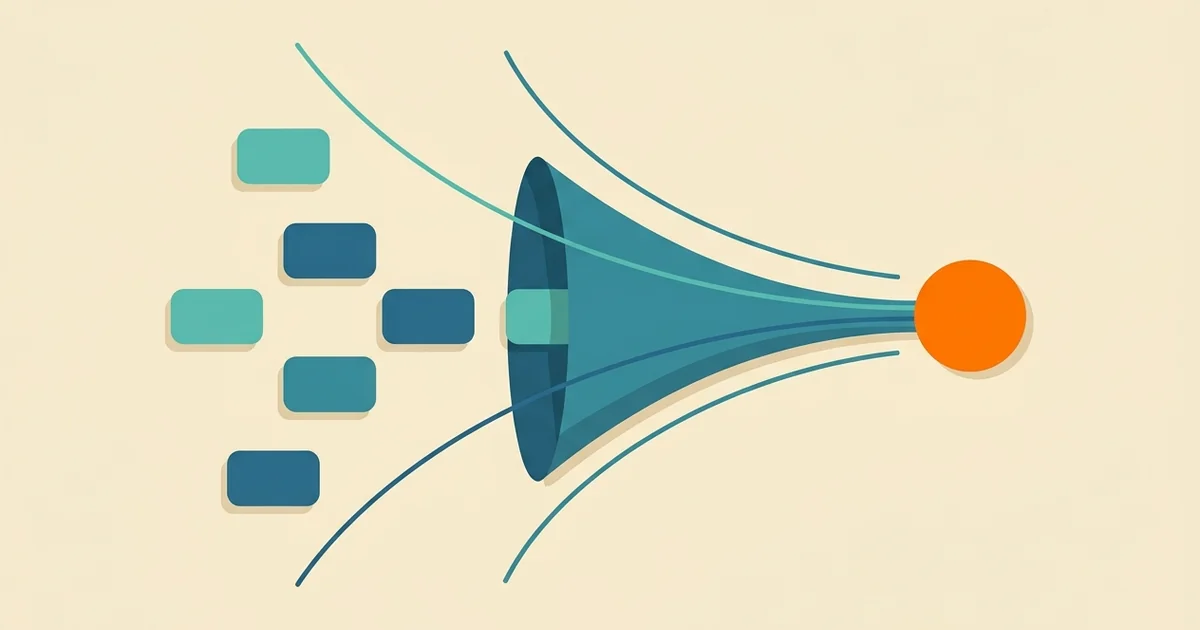
The funnel introduction structure is a broad-to-narrow pattern that moves from a wider topic area to a specific research question. It starts with a relevant opening context, narrows to the problem or gap, then ends with the paper’s aim, question, or argument. The structure helps students avoid both vague openings and abrupt research questions.
How the funnel works
Funnel introduction structure means arranging the introduction so that each paragraph reduces the scope. The top of the funnel gives context. The middle explains the problem and rationale. The bottom states the focused research question or aim.
A typical funnel might look like this:
- Broad but relevant field context
- Specific issue within that field
- Existing research, debate, or practical concern
- Gap, limitation, uncertainty, or unresolved problem
- Aim and research question
- Optional scope or structure sentence
The funnel does not mean starting with the whole history of the topic. “Broad” means broad enough to orient the reader, not broad enough to include everything. In a nursing paper on medication adherence after hospital discharge, the top of the funnel might be care transitions for older adults, not the entire healthcare system.
Weak versus stronger funnel movement
| Weak student version | Stronger academic rewrite |
|---|---|
| “Social media is very popular and affects people in many ways. Students use it every day. This paper will look at social media and sleep.” | “Late-night social media use has become a recurring concern in studies of undergraduate wellbeing because it may interfere with sleep routines and next-day concentration. This paper examines how evening social media use is associated with self-reported sleep quality among first-year university students.” |
| “Nurses have many responsibilities. Medication is important. This paper is about older patients taking medication.” | “Medication adherence after discharge is a common concern in home care because older adults may leave hospital with changed prescriptions, limited follow-up, and competing health needs. This paper focuses on barriers to adherence among older patients discharged to community nursing support.” |
| “Many companies want employees to be happy. Remote work is common now. I will research remote work.” | “As hybrid work becomes routine in service organisations, managers face questions about how reduced office contact affects early-career employees’ belonging and communication. This paper investigates perceived team inclusion among graduate employees working under hybrid arrangements.” |
Notice that the stronger versions do not merely sound more formal. They narrow the topic by naming a group, context, relationship, and direction.
Where students lose the funnel
Students often lose the funnel by jumping sideways. A paragraph starts with student wellbeing, then shifts to technology addiction, then to university policy, then to mental health services. All of these may be related, but they do not all belong in the opening unless they directly prepare the research question.
A good test is to ask whether each sentence brings the reader closer to the research question. If a sentence only proves that the general topic is broad, current, or socially relevant, it may belong in your notes rather than the introduction.
How should you open a research paper introduction without sounding generic?
Open a research paper introduction with a specific issue, tension, pattern, or problem that your paper will actually address. Avoid global claims, dictionary definitions, and vague statements about importance. A clear opening gives the reader a reason to keep reading without pretending that the paper will solve an entire field-wide issue.
Start with a concrete academic problem
The first sentence should locate the paper inside a recognisable academic or practical concern. That does not mean using dramatic language. It means giving the reader a precise entry point.
For example, in education, a paper on formative feedback might open with a problem faced by first-year students who receive extensive comments but do not use them in later assignments. That opening is more useful than “Feedback is important in education,” because it points toward a specific mismatch between feedback provision and student uptake.
In business and management, a paper on hybrid work could open with the tension between flexibility and social integration for new employees. In health sciences, a nursing paper could open with discharge planning and medication adherence among older adults receiving home care. In psychology, a paper could open with the relationship between academic stress, sleep, and self-regulation among undergraduates.
Avoid empty opening formulas
Many weak introductions begin with sentences that are grammatically correct but academically unhelpful:
Weak: “Since the beginning of time, people have communicated with each other.”
Stronger: “In first-year university seminars, participation often depends not only on preparation but also on students’ confidence in speaking before peers.”
The stronger version works because it has a setting, a group, and a problem. It also limits the reader’s expectations. The paper will not explain all human communication; it will examine seminar participation in a defined student context.
Another weak opening is the dictionary-definition opener:
Weak: “Motivation is defined as the reason why people do something.”
Stronger: “In undergraduate online courses, motivation becomes visible through behaviours such as logging in regularly, completing low-stakes quizzes, and contributing to discussion boards.”
Definitions can be useful, but the first sentence usually needs a problem or focus, not a generic definition.
Use an opening that matches the paper type
Different paper types need different kinds of openings. A theoretical paper may begin with a conceptual tension, such as two competing definitions of “digital inclusion.” A literature review may begin with an area of debate and the need to group existing research. An empirical paper may begin with a context where a relationship, experience, or outcome needs investigation.
A thesis can be an undergraduate or master’s research document in the United States; a doctoral document is commonly called a dissertation, with local variations. Use the actual program requirements. A term paper, seminar paper, or capstone should follow its own prompt rather than inherit a thesis structure because a search result uses that label.
How do you explain the rationale and research gap in an introduction?
Explain the rationale by showing why your paper’s focus deserves attention in this assignment, field, or practical context. Explain the research gap by identifying what existing work has not settled, compared, applied, defined, or examined in your chosen scope. The rationale answers “why this matters,” while the gap answers “why this paper is needed.”
Difference between rationale and gap
Rationale means the reason your paper is worth writing. It may be academic, practical, methodological, theoretical, or educational.
Research gap means the specific missing, limited, underdeveloped, contested, or under-applied part of existing knowledge that your paper responds to. A gap does not have to mean “nobody has ever studied this.” At undergraduate and master’s level, it often means a narrower gap within a course topic, population, context, theory, or comparison.
For example, a psychology paper might focus on how first-year students describe stress and bedtime routines during assessment periods. A nursing paper might examine patients’ accounts of managing medication after discharge; a law paper might examine a defined tension between policies and procedural fairness. These are invented writing examples, not verified research gaps. A course’s limited discussion of an issue is an educational rationale, not evidence that scholarly research is missing.
If you are still trying to locate the gap, use source clusters rather than isolated summaries. The article on source clusters revealing a research gap gives a clearer method for seeing what your introduction needs to justify.
Rationale sentences that work
A useful rationale sentence connects the topic to a consequence, debate, or decision. It does not merely say that the topic is “interesting” or “relevant.”
Try these patterns:
- “This focus matters because [group/context] faces [specific problem or decision].”
- “The issue is academically relevant because existing work tends to emphasise [X], while giving less attention to [Y].”
- “For this paper, the problem is limited to [scope] because [reason].”
- “Examining [specific relationship] may clarify [limited outcome, concept, or debate].”
A rationale should be proportionate. A 2,500-word seminar paper does not need to claim it will transform policy. It can justify a focused comparison, interpretation, or small empirical question.
Gap language without exaggeration
Avoid saying “no research exists” unless you have done a systematic search and can defend that claim. Safer and more accurate phrasing often works better:
- “Less attention has been paid to…”
- “Existing discussions often focus on…, whereas this paper focuses on…”
- “The relationship between… remains unclear in the context of…”
- “This course paper examines [defined issue] to clarify [specific comparison or interpretation]…”
- “This paper addresses that limitation by…”
For literature-heavy papers, the introduction should prepare the reader for synthesis, not list every source. If your background paragraph is turning into source-by-source notes, move that material into the literature review and use thematic literature review source clusters to organise it.
How do introductions differ across quantitative, qualitative, theoretical, and literature review papers?
Introductions differ because each research type leads the reader toward a different kind of answer. Quantitative introductions usually narrow toward variables, hypotheses, and measurable relationships. Qualitative introductions narrow toward experiences, meanings, or processes, while theoretical and literature review introductions narrow toward concepts, debates, or patterns in existing scholarship.
Quantitative empirical introductions
A quantitative introduction should prepare readers for the study’s numerical evidence and research question. Identify relevant measures, population or cases, and the rationale for any comparisons or hypotheses. Descriptive and exploratory quantitative studies do not always test a predicted relationship or require formal hypotheses.
Variable means a feature that can vary across cases, such as stress level, sleep quality, study hours, medication adherence, or job satisfaction. If your introduction uses a term as a variable, it should become measurable later in the paper.
Example:
“Among first-year psychology students, assessment-related stress may be associated with shorter sleep duration and poorer perceived sleep quality. This paper examines the relationship between self-reported academic stress and sleep quality during the final assessment period.”
This introduction path works because it leads naturally to a quantitative research question or hypothesis. If your paper includes hypotheses, connect them to aims and objectives rather than dropping them in without context. The article on research aims and objectives branching into hypotheses can help keep that sequence clear.
Qualitative empirical introductions
A qualitative introduction prepares the reader for interpretation rather than measurement. It usually focuses on lived experience, perceptions, meanings, practices, or processes.
Example from nursing:
“Older adults discharged after medication changes may receive written instructions but still experience uncertainty when managing multiple prescriptions at home. This paper explores how older home-care patients describe barriers to following discharge medication plans.”
The wording points toward participant experience. It does not promise to measure the size of the problem across a large population. It also keeps the scope manageable for a student research project.
A qualitative introduction often ends with a “how” or “what” question, such as “How do first-year students describe…” or “What barriers do patients report…?” The opening should create a reason for asking that kind of question.
Theoretical and literature review introductions
A theoretical paper introduction narrows toward a conceptual problem or argumentative claim. It might compare two theories, test a concept’s usefulness, or argue that a framework needs adjustment.
Example from business ethics:
“Discussions of corporate social responsibility often distinguish between compliance-based and values-based approaches, but this distinction becomes harder to apply when companies use automated decision systems. This paper argues that accountability offers a more useful lens for analysing ethical responsibility in algorithmic management.”
A literature review introduction, by contrast, narrows toward the organising focus of the review. It should explain what body of research is being reviewed, why it is being grouped, and what theme or question controls the review. A thematic source cluster approach to the literature review can stop the introduction from becoming a reading list.
What mistakes do students commonly make when writing an academic introduction?
Students commonly weaken introductions by opening too broadly, delaying the research question, confusing topic with problem, overloading the first page with sources, or using claims that exceed the paper’s scope. These mistakes make the paper look less focused even when the student has done useful reading. Each problem can be corrected by narrowing the wording and making the logic of the paper visible earlier.
Mistakes with examples and corrections
-
The “whole world” opener
Student example: “Technology has changed the way people live, work, and communicate in modern society.”
Correction: Replace the global claim with the specific context your paper studies: “In hybrid university courses, discussion boards often replace informal classroom exchanges, which may affect how first-year students ask for help.” -
The delayed research question
Student example: The introduction spends two pages on social media history, smartphone use, online communities, and mental health before asking, “How does TikTok use affect sleep among undergraduates?”
Correction: Introduce the population and outcome early, then use the background to justify the question rather than burying it. -
The topic-without-problem introduction
Student example: “This paper is about medication adherence in elderly patients.”
Correction: Add the problem, context, and consequence: “This paper examines why older adults discharged to home care may struggle to follow changed medication schedules after hospitalisation.” -
The source pile-up
Student example: “Smith says feedback is useful. Jones says students need feedback. Ahmed says feedback improves learning. Brown says online feedback is common.”
Correction: Group sources by idea: “Existing work commonly presents feedback as a tool for learning improvement, but less attention is given to how first-year students decide whether to use comments in later assignments.” -
The overpromising aim
Student example: “This paper will solve the problem of low motivation in online education.”
Correction: Scale the aim to the assignment: “This paper examines how weekly quiz deadlines may support engagement in an undergraduate online course.”
Before and after revision table
| Introduction element | Weak version | Stronger version |
|---|---|---|
| Opening | “Mental health is a big issue for students.” | “During assessment periods, first-year students often report changes in sleep, routine, and concentration.” |
| Rationale | “This topic is very relevant today.” | “The focus matters because early academic adjustment may affect students’ ability to manage workload and seek support.” |
| Gap | “There is not enough research.” | “Course discussions often treat stress and sleep separately, leaving their day-to-day connection less clearly explained.” |
| Research question | “What about stress and sleep?” | “How do first-year psychology students describe the relationship between assessment stress and sleep routines?” |
| Scope | “This paper will discuss students.” | “The paper focuses on first-year undergraduate psychology students during the final assessment period.” |
The stronger versions do more than add formal wording. They make the paper’s logic visible: context, reason, gap, question, and boundary.
How can you revise an academic introduction before drafting the next section?
Revise an academic introduction by checking whether every paragraph moves the reader closer to the research question. Cut background that does not support the problem, sharpen the rationale, make the gap precise, and confirm that the final aim matches the rest of the paper. A revised introduction should act as a map for the paper, not a decorative opening.
A practical revision process
Use this process after you have a rough introduction, not before you draft anything:
- Underline the sentence that states the specific topic.
- Circle the sentence that explains the problem or tension.
- Box the sentence that gives the rationale.
- Mark the sentence that identifies the gap, limitation, or need.
- Highlight the research question, aim, or thesis claim.
- Cross out any sentence that does not support one of those functions.
- Check whether the research question matches your method, paper type, and assignment brief.
- Rewrite the opening paragraph so the reader reaches the problem faster.
If you cannot find one of these elements, your introduction may not yet be doing its job. If you find three different versions of the research question, choose one and adjust the rest of the introduction around it.
Matching the introduction to the rest of the paper
The introduction should connect to the next section. If the next section is a literature review, the introduction should prepare the themes and gap. If the next section is methodology, the introduction should make the research design feel justified. If the paper is theoretical, the introduction should prepare the concept or debate that the argument will develop.
A common problem appears when the introduction promises one project but the body delivers another. For example, the introduction asks about “student motivation,” but the body only discusses attendance. Or the introduction promises a comparison of two theories, but the paper mainly summarises one. This mismatch usually means the introduction was written before the paper’s structure became clear.
Before you move on: academic introduction checklist
- The opening sentence names a specific issue, context, or tension rather than a global claim.
- The introduction gives enough background to orient the reader, but not a full literature review.
- The rationale explains why this focus matters for the assignment, field, group, or problem.
- The gap is stated without exaggerating what existing research has or has not done.
- The research question, aim, or thesis claim appears clearly before the introduction ends.
- The scope is realistic for an undergraduate or master’s paper.
- Key terms are introduced only when they help the reader understand the paper’s focus.
- The introduction matches the paper type: quantitative, qualitative, theoretical, or literature review.
- Each paragraph serves the introduction’s purpose, whether by orienting the reader, explaining the problem, or establishing the argument.
- The final sentences prepare the reader for the next section of the paper.
For further guidance, see UNC: functions of introductions and Harvard: framing the question and thesis. These resources offer writing guidance in specific contexts; they do not validate the invented examples in this guide or replace assignment requirements.
Frequently Asked Questions
How long should an academic introduction be?
There is no universal percentage or word count for an academic introduction. Follow the assignment or publication requirements and include enough context, rationale, and focus for the reader to follow the paper. A longer document may require a different structure, rather than simply a proportionally longer opening.
What is the difference between a research paper introduction and a literature review?
A research paper introduction frames the problem and leads to the research question. A literature review analyses and groups existing scholarship in more depth. The introduction may mention key research trends, but it should not become a source-by-source review.
Can an undergraduate paper have a research gap?
Yes, an undergraduate paper can address an evidence-supported research gap or a focused analytical problem. A comparison assigned in a course can be worthwhile without being new to scholarship. Distinguish that educational purpose from a claim that existing research has overlooked the issue.
Should a master’s paper introduction include hypotheses?
A master’s paper introduction should include hypotheses if the project is quantitative and the assignment expects them. The hypotheses should follow from the rationale, variables, and research question. Qualitative, theoretical, and literature review papers usually use questions, aims, or claims instead.
How many sources should appear in the introduction?
Use only the sources needed to establish context, rationale, and gap. Many introductions need a small number of key sources rather than a long list. If a paragraph mainly summarises studies one after another, move that material into the literature review.
Can I write the introduction after the body?
Yes, many students draft the introduction early and revise it after writing the body. The final version often becomes clearer once the argument, method, and scope are settled. Keep the opening flexible until the research question and paper structure are stable.