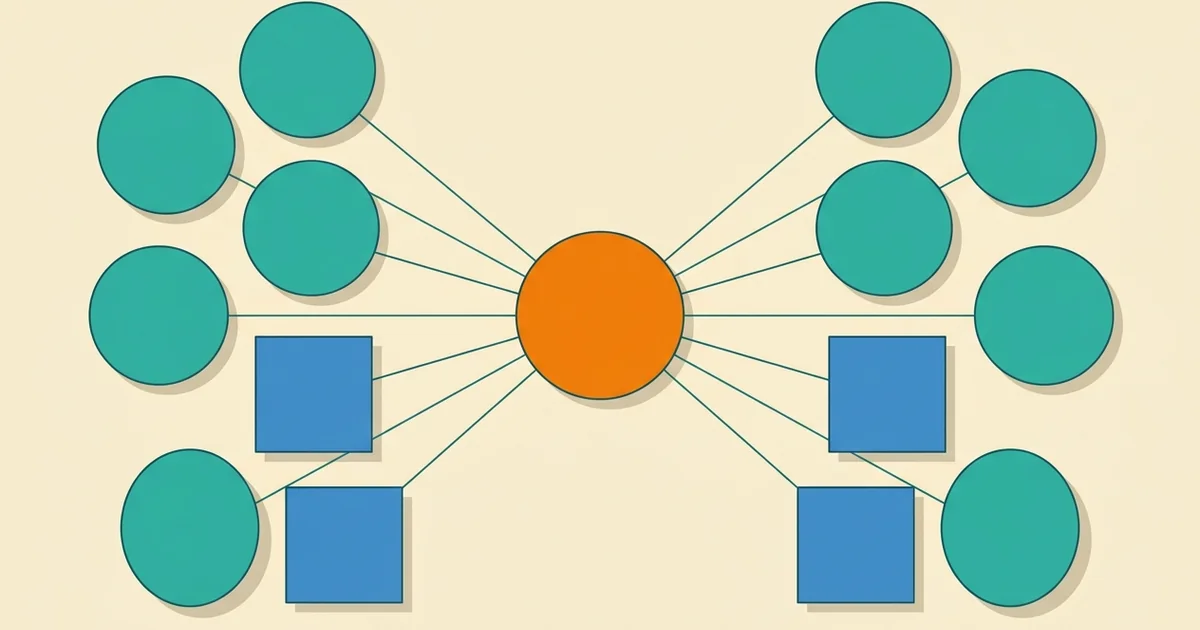
A thematic literature review groups sources around concepts, debates or questions. Choose and revise themes against the assignment, review scope and evidence; compare sources without forcing agreement or a fixed theme count. Thematic, chronological, methodological and theoretical structures can also be combined.
Thematic Literature Review: How to Structure a Literature Review by Themes
A review can become a reading log when it reports each source without explaining how the sources relate. Thematic organization offers one way to develop those relationships: group evidence around questions or concepts, then compare it. Choose the structure that serves your assignment; a chronological review can also synthesize evidence.
A thematic literature review groups sources around shared concepts, debates or questions. Sections explain relationships between relevant sources and their implications for the review’s purpose. This guide concerns organization in a research paper / term paper, thesis or capstone; it does not prescribe a formal thematic analysis or thematic synthesis method.
The examples below are invented teaching material. Records A, B and C are placeholders, not published studies; their observations must not be cited as research findings.
In this guide
- What is a thematic literature review?
- Why organize a literature review by themes instead of chronology?
- How do you find themes in your sources?
- How do you turn source notes into a thematic literature review structure?
- What should each thematic section include?
- How do thematic literature reviews differ across research types?
- What mistakes do students commonly make when writing a thematic literature review?
- How can you revise a thematic literature review before drafting the final paper?
What is a thematic literature review?
A thematic literature review is a literature review structure that groups sources by recurring ideas rather than by publication date or author. Each section focuses on a theme and uses several sources to compare what researchers agree on, disagree about, measure differently, or leave unresolved. The goal is not to prove that you have read many articles; it is to show how the existing literature shapes your own paper.
Definition in plain language
Theme means a repeated pattern, issue, concept, or debate that appears across several sources. A theme is not just a topic label like “social media” or “nursing.” It is more specific, such as “social comparison as a mechanism linking Instagram use to anxiety” or “discharge communication as a barrier to medication adherence.”
Synthesis connects evidence from sources to explain a relationship, including agreement, difference or limits on comparison. In our invented example, record A notes written feedback on drafts, B notes spoken feedback on drafts, and C notes written comments on final submissions. Grouping A and B by timing, then comparing them with C, creates an organizing question without claiming that one approach improves learning.
A thematic approach is especially useful when your assignment asks you to establish a research gap, justify a research question, or build a conceptual basis for your study. For a fuller distinction between listing and integrating evidence, see Source evidence synthesized into a central literature review claim.
What counts as a theme?
A theme can come from theory, method, population, outcome, context, or disagreement. In psychology, a student writing about social media and anxiety might use themes such as “social comparison,” “sleep disruption,” and “measurement of screen time.” In nursing, a student writing about medication adherence after hospital discharge might use themes such as “patient education,” “family caregiver involvement,” and “follow-up communication.”
A theme becomes useful when it helps the reader understand the literature more clearly than a source-by-source order would. “Study 1, Study 2, Study 3” is not a theme. “Different definitions of adherence” is a theme because it explains why findings may not line up across studies.
Why organize a literature review by themes instead of chronology?
A thematic structure places evidence about a shared question together. Chronological, methodological and theoretical organization can be equally appropriate, depending on the review’s purpose. Both chronological and thematic reviews need analysis; neither structure guarantees it.
Chronological order can become a timeline trap
A list of publication dates can obscure relationships if it merely retells articles. A chronological analysis can instead compare how definitions, evidence or methods change across periods. Thematic organization can help when those periods are less relevant than the questions shared by sources.
For example, a review of feedback practices might use a chronology if a policy change defines its question, or organize by feedback timing if that is its focus. Either structure can contain the other as subsections.
Thematic order makes comparison easier
Thematic sections let you place sources beside one another. That makes it easier to answer questions such as: Do studies define the concept in the same way? Do they use similar methods? Do they reach compatible findings? Do they examine the same population?
| Separate notes from the invented records | Possible thematic comparison |
|---|---|
| A describes written draft comments; B describes spoken draft comments. | Compare written and spoken feedback within the draft-feedback theme. |
| C describes written comments on a final submission. | Compare feedback timing across A, B and C without assuming equivalent outcomes. |
| A and C both concern written comments. | The same records can also support a theme about feedback format. |
| The records do not supply learning outcome data. | Do not infer that a format or timing improves learning from these notes. |
This kind of structure gives the reader a map of the field rather than a pile of summaries.
How do you find themes in your sources?
You find themes by reading for patterns across sources: repeated concepts, shared variables, common methods, similar findings, contradictions, and gaps. Start with your research question, then code your notes so that each source can belong to more than one theme. Themes usually appear after you compare several sources, not after reading only one article.
Start with your research question and scope
Before you start sorting sources, make sure your topic is focused enough. A review on “technology in education” is too wide to organize well because almost every theme becomes possible. A review on “teacher feedback tools and student engagement in first-year university writing courses” gives you clearer boundaries.
If your topic still feels too broad, use a narrowing process before building the review. The article Broad idea narrowing into a focused research problem can help you reduce the scope before you spend hours sorting sources you may not use.
Scope defines the review’s boundaries, such as population, setting, period, discipline or concept. Justify these boundaries using the assignment and question; degree level alone does not determine a date window, country restriction or source type.
Code sources for repeated ideas
Coding does not need to be complicated. Create a table with columns for citation, research aim, method, population, key concept, finding, limitation, and possible theme. Then add short labels when you see a repeated pattern.
For example, a psychology paper on smartphone use and anxiety might produce codes such as “night-time use,” “social comparison,” “notification checking,” “self-report bias,” and “cross-sectional design.” After reading more sources, those codes may merge into themes: “mechanisms linking phone use to anxiety” and “measurement problems in screen-time research.”
Do not force every source into only one category. A single study can support a methods theme and a findings theme. That overlap is often where useful synthesis begins.
Use a theme matrix
A theme matrix helps you see which sources support each section before you write. Put themes across the top and sources down the side. Mark where each source contributes evidence, disagreement, definition, method, or limitation.
- List the relevant sources you have assessed in the first column.
- Add provisional columns for questions or concepts emerging from that reading.
- Mark each source under every theme it contributes to.
- Add a note about what the source does in that theme: defines, supports, challenges, measures, or limits.
- Investigate sparse columns: search further, qualify coverage, merge or remove them as the review’s purpose requires.
- Rename themes so they express an analytical idea, not just a broad topic.
A matrix makes coverage visible; it does not establish that the wider literature lacks evidence. A section may closely examine a foundational or disputed source when justified. The relevant question is what the evidence supports, not whether a numerical minimum has been met.
How do you turn source notes into a thematic literature review structure?
Group related evidence, label each group precisely and arrange the groups to serve the review question. Broad-to-narrow is one option; other useful orders compare approaches, contexts or periods. An assignment may ask for a synthesis of existing knowledge without proposing a new study or original gap.
Choose themes that fit the question and evidence
There is no universal number of themes. Check the assignment, available space, overlap and evidence coverage. Split a section when distinct questions need separate treatment; merge sections when they repeat the same comparison. Do not invent extra themes to meet a target.
For a research paper / term paper on remote work and burnout, provisional topics to test against actual sources could be:
- workload and digital over-availability
- autonomy and schedule control
- manager support and team communication
- differences between hybrid and fully remote work
These are possible organizing questions, not findings about remote work. Keep a topic only when the assessed sources and assignment justify it; do not assume it has a causal explanation or sufficient coverage.
Arrange themes in a logical order
In the invented feedback example, one possible order defines draft and final-submission feedback, compares written and spoken formats, then considers how timing and format overlap. Another order could place timing first. Neither establishes a learning effect. Explain the order you choose and check it against the full records.
For help turning assignment requirements into a structure before drafting, see Assignment brief requirements turning into a paper plan.
Write section headings as claims when possible
A heading can identify a question, a comparison or a supported claim. Do not turn a provisional theme into an empirical conclusion before checking the evidence. Descriptive headings can be appropriate, including under a required template.
| Broad heading | More focused heading for the invented feedback example |
|---|---|
| Feedback | Timing of feedback: drafts and final submissions |
| Written Comments | Written comments across different submission stages |
| Spoken Feedback | Comparing spoken and written draft feedback |
| Outcomes | What these records do not establish about learning |
These headings organize the teaching records; they do not report findings from published research.
What should each thematic section include?
Give each section a clear purpose, accurately represented evidence and an explanation of how it contributes to the review. Compare sources where appropriate, while allowing detailed evaluation of a key work. Not every paragraph needs several citations or a statement of a gap.
Open with the point of the section
Introduce the section’s question or supported point. An author-led opening is also appropriate when introducing a foundational study or evaluating a particular argument.
Invented example: Records A and B both concern draft feedback but use different formats; record C concerns written feedback on a final submission. The comparison therefore needs to distinguish timing from format.
This opening gives the section a purpose without claiming that any feedback practice is more effective.
Compare sources inside the paragraph
For the invented records, a paragraph might read: “A and B share the draft stage, while A and C share written format. These overlapping groupings support separate comparisons of timing and format. The notes contain no learning outcome data, so they do not establish an effect on achievement.”
In a submitted review, replace the placeholders with checked sources and citations, assess methods and populations, and limit each conclusion to what those sources support. Sources need not disagree; do not manufacture a debate.
End with a link to your paper
Each section should bring the reader closer to your own purpose. That link might show a gap, justify a method, explain a variable, or refine the research question.
For a quantitative paper, a thematic section might end by identifying which variables need to be measured. If you are defining variables for a survey or statistical analysis, a guide to defining quantitative variables gives a useful next step.
For a literature review paper, a section might end by explaining which debate remains unresolved. For a theoretical paper, it may show which concepts need to be connected or distinguished.
How do thematic literature reviews differ across research types?
Thematic literature reviews differ by research type because each type uses the literature for a different purpose. Quantitative reviews often organize themes around variables, measurement, and empirical relationships. Qualitative, theoretical, and literature-based papers may organize themes around meanings, concepts, perspectives, or debates.
Quantitative empirical papers
In quantitative empirical research, themes often support your model or hypotheses. You may organize the review around the independent variable, dependent variable, mediators, moderators, measurement issues, and prior findings.
For example, a psychology student studying the relationship between sleep quality and academic stress among undergraduates might use themes such as:
- definitions and measurement of sleep quality
- academic stress as a predictor of wellbeing
- prior evidence linking sleep and stress
- possible confounding variables, such as work hours or screen use
This structure prepares the reader for hypotheses because it explains each variable and the expected relationship between them.
Qualitative empirical papers
In qualitative research, themes often come from experiences, meanings, contexts, or social processes. The literature review still needs structure, but it may not build toward testable hypotheses.
For example, an education student studying first-generation students’ experiences of academic feedback could organize the review around “feedback literacy,” “belonging and academic identity,” and “institutional communication.” These themes help frame interview questions and explain why student experiences may differ across contexts.
A qualitative thematic review should also address how previous researchers have interpreted similar experiences. That means comparing conceptual lenses, not just findings.
Theoretical, conceptual, and literature review papers
Theoretical and conceptual papers use themes to build an argument between ideas. A literature review paper may use themes to compare positions, identify unresolved questions, or propose a new way to connect concepts.
For example, a business student writing a conceptual capstone on ethical leadership and employee voice could use themes such as “leader moral behaviour,” “psychological safety,” and “voice climate.” The structure shows how the concepts relate before the student proposes a framework or argument.
A standalone literature review needs a clear organizing claim even when it does not collect new data. The article Thematic source clusters and research gap for a literature review gives a broader view of how source clusters can support a complete review.
What mistakes do students commonly make when writing a thematic literature review?
Common problems include vague themes, unsupported generalizations, redundant sections and comparisons that overlook important differences. A source-focused paragraph is not itself an error; assess its purpose in the review.
Mistakes that weaken thematic structure
- Vague labels: Replace “Feedback” with a question about timing or format when the sources support that focus.
- Unconnected notes: Explain how the invented records A, B and C overlap instead of simply listing them.
- Arbitrary source thresholds: Evaluate whether a section’s role and evidence justify its treatment, including close analysis of one important work.
- Unsupported effects: Do not turn descriptions of feedback practices into claims about improved achievement.
- Invented gaps: An empty matrix cell only describes your notes. A claim about missing research needs an appropriate search and a qualified account of its limits; some assignments do not require such a claim.
Why these mistakes happen
Most of these mistakes come from drafting too early. Students begin writing before they have compared sources in a matrix or mapped themes against the research question. The result is a review that sounds informed but does not yet have an argument.
Another cause is fear of leaving sources out. A literature review does not need to include every sentence you noted. It needs to use the most relevant evidence to explain the state of the literature and the reason your paper exists.
How can you revise a thematic literature review before drafting the final paper?
Revise by checking each section’s purpose, evidence and contribution to the review question. Look at structure before style, including whether comparisons are justified and whether focused treatment of a single work has a clear role.
Test the section order
Read the headings in order and explain why that sequence helps the reader. Some parallel themes can be reordered without harming the review; the ability to shuffle them is not a quality verdict.
Ask three questions:
- Does the first theme give the reader necessary background?
- Does each later theme narrow, complicate, or extend the discussion?
- Does the final theme point naturally toward the gap, research question, or aim?
If the answer is no, reorder the sections before revising paragraphs. Moving one theme earlier can make the whole review easier to follow.
Check for synthesis, not coverage
Many students revise by adding more sources. That can help, but only if the new sources strengthen comparison. More citations do not automatically create better synthesis.
Check where the review compares sources and where it summarizes or evaluates an individual work. Both can serve a purpose; revise passages whose relevance or evidential basis is unclear.
A useful test is the “so what?” question. After each paragraph, ask: What does this mean for my research question, method, hypothesis, or argument? If you cannot answer, the paragraph may not belong in the review.
Before you move on: thematic literature review checklist
- My review is organized by themes, not by the order in which I read the sources.
- Each theme has a precise name that signals an analytical pattern.
- Evidence coverage and the treatment of important individual sources are justified.
- I compare definitions, methods, findings, or limitations inside each section.
- I explain disagreements or mixed findings instead of hiding them.
- My section order serves the review question and assignment.
- I avoid one-author paragraphs unless a source is being introduced for a specific reason.
- My openings explain the purpose of each passage without overstating the evidence.
- I connect each theme back to my research question, aim, or paper purpose.
- I have removed themes that are interesting but outside my assignment scope.
- My final review makes the need for my paper clear without overstating the evidence.
Further guidance
Purdue OWL: Writing a Literature Review and UNC Writing Center: Literature Reviews explain organizational choices and the role of assignment requirements.
Frequently Asked Questions
What is the difference between a thematic and chronological literature review?
A thematic review groups sources around concepts or questions; a chronological review organizes them around developments over time. Both can synthesize evidence, and they can be combined. Choose according to the assignment, literature and purpose.
How many themes should an undergraduate literature review have?
There is no universal number. Use the assignment, word limit, question and assessed evidence to decide. Merge repetitive sections and split distinct questions when their treatment needs space; do not judge quality by a theme count.
How long should each theme section be?
Give each section the space needed to develop its question and assess the relevant evidence within the word limit. Sections need not have equal lengths or a fixed number of sources. Use subthemes when distinct comparisons need separate treatment, subject to the assignment’s format.
Can a source appear in more than one theme?
Yes, a source can appear in more than one theme if it contributes to different parts of the review. For example, one study may be relevant to both “measurement of anxiety” and “social comparison as a mechanism.” Reusing a source is acceptable when each use has a clear purpose.
Is a thematic literature review suitable for master’s level work?
Yes, a thematic literature review is often suitable for master’s level coursework, research papers, and capstone projects. At master’s level, the themes usually need deeper comparison, clearer engagement with theory or method, and a stronger link to the research problem. The structure should still remain focused and readable.
Should I write the literature review before or after the research question?
A provisional research question should come before the full literature review, but the review may refine the question as you read. If your themes reveal that the topic is too broad, too narrow, or already well covered, adjust the question. The final version of the review and question should fit together.