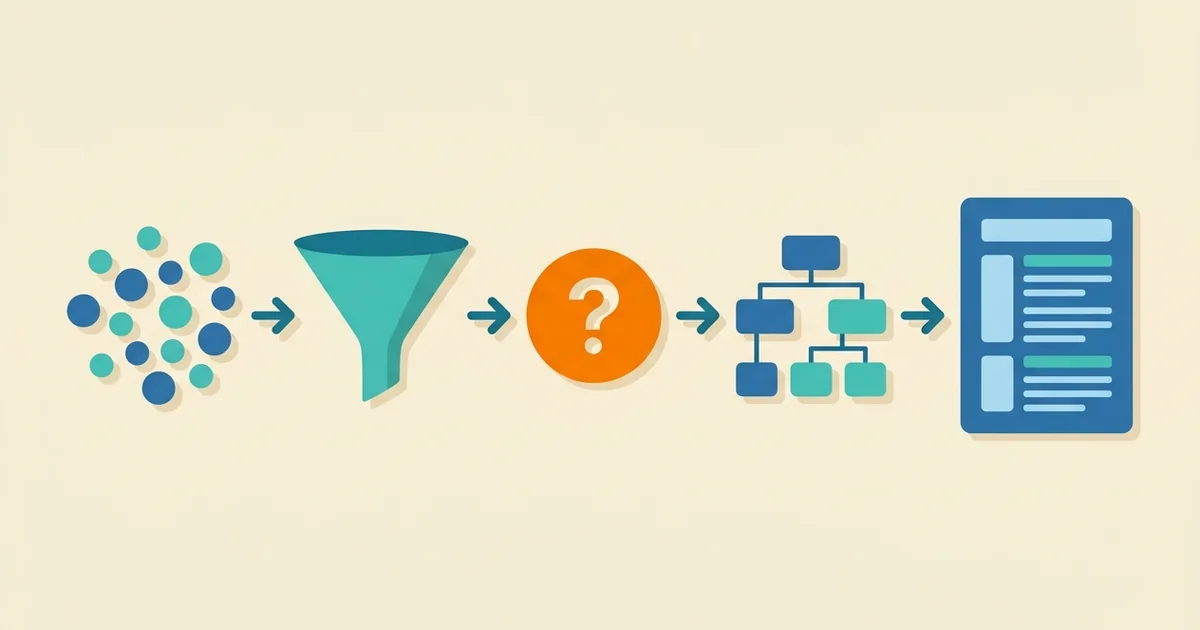
An academic paper workflow turns the assignment brief into a sequence of decisions: requirements, topic, research question, method or argument, outline, source plan, first draft, and revision. Make the decisions visible and revisit them as reading and drafting develop; the process need not be strictly linear.
Academic paper workflow: from assignment brief to first draft
You open the assignment brief, understand most of the words, and still do not know what to write on page one. The deadline is close enough to feel real, but the task is still a blur: topic, sources, research question, outline, method, draft, references. That is where many students lose time. They start writing because writing feels productive, then discover halfway through that the paper does not answer the brief, the scope is too broad, or the evidence does not support the claim. A practical academic paper workflow prevents that spiral by turning one vague task into smaller decisions you can check before the draft grows too large to control.
An academic paper workflow turns the assignment brief into a sequence of decisions: requirements, topic, research question, method or argument, outline, source plan, first draft, and revision. Make the decisions visible and revisit them as reading and drafting develop; the process need not be strictly linear.
This guide distinguishes a student’s general writing process from the Texio order. Texio orders a complete model paper: paper details and payment come before plan review, editing and approval, then drafting. Planning fields, companion documents and reports depend on the work type and available checks; they are not a promise of a fully verified or submission-ready paper. Texio does not offer a standalone chapter, research proposal, thesis, dissertation or capstone/final project, or perform statistical analysis or qualitative coding. Follow your course’s AI policy and disclosure requirements; rewriting AI text alone does not make a prohibited use permissible.
In this guide
- How does an academic paper workflow move from assignment brief to first draft?
- How do you turn an assignment brief into usable writing requirements?
- How do you choose a topic that fits the paper length and deadline?
- How do you develop a research question, aims, and hypothesis?
- How do you build an outline before drafting paragraphs?
- How do you move from sources to a literature review section?
- How do different research types change the research paper process?
- What mistakes do students commonly make when moving from assignment to draft?
- How do you revise the first draft before submission?
How does an academic paper workflow move from assignment brief to first draft?
An academic paper workflow moves from task interpretation to planning, then from planning to controlled drafting. The process begins with the assignment brief, not with a blank document, because the brief defines the paper type, scope, evidence expectations, and marking criteria. A first draft is the result of linked decisions, not a single burst of writing.
The basic sequence
The workflow below fits term papers, research papers, capstone projects, and seminar papers at undergraduate and master’s level. It also works across quantitative, qualitative, theoretical, and literature review papers, although the middle stages change depending on the type of research.
- Read the assignment brief and extract the requirements.
- Choose a topic that fits the word count, course focus, and available evidence.
- Narrow the topic into a research problem or argument focus.
- Write a research question, aim, and, where relevant, hypotheses.
- Choose a research type: empirical quantitative, empirical qualitative, theoretical, conceptual, or literature-based.
- Build an outline with section purposes, not only section titles.
- Gather and evaluate academic sources.
- Draft section by section, starting from the easiest planned section if needed.
- Produce a quality check and revise the draft against the brief.
Key terms used in the workflow
Assignment brief means the official task instructions, including question wording, learning outcomes, formatting rules, weighting, and assessment criteria. Research paper process means the chain of choices that connects the brief to the finished academic text. First draft means a complete working version of the paper that has all required sections, even if the argument, sources, style, and structure still need revision.
The goal is not to make the first draft perfect. The goal is to make it complete enough that revision becomes possible. A half-written introduction and a pile of sources do not give you much to revise; a structured draft does.
How do you turn an assignment brief into usable writing requirements?
You turn an assignment brief into writing requirements by identifying what the task asks you to do, what evidence it expects, and how the paper will be assessed. The brief usually contains more structure than it first appears to contain. Extracting that structure reduces guesswork before you choose a topic or start drafting.
Read for commands, limits, and evidence
Look for command verbs first. Words such as “analyse,” “compare,” “evaluate,” “apply,” “discuss,” and “critically assess” tell you what kind of thinking the paper must show. “Describe” usually asks for explanation; “evaluate” asks for judgement; “compare” asks for similarities and differences linked to a point.
Then mark the limits. These may include word count, date range, case type, module themes, required number of sources, required method, formatting style, or named theories. If the assignment says “use peer-reviewed sources from the last ten years,” a paper built on news articles and older textbook chapters will not fit, even if the writing sounds polished.
For a more detailed planning example, see assignment brief requirements turning into a paper plan.
Convert the brief into a planning table
A brief becomes useful when you turn it into concrete writing decisions. The table below shows how vague task reading becomes a workable plan.
| Brief element | Weak student interpretation | Better workflow decision |
|---|---|---|
| “Critically evaluate two interventions” | “Write about two interventions I find online.” | Compare two named interventions using effectiveness, limitations, and implementation evidence. |
| “Use academic sources” | “Add references after writing.” | Search peer-reviewed journal articles before outlining the main sections. |
| “2,500 words” | “Cover the whole topic briefly.” | Allocate space to the required functions and narrow the topic where needed; no fixed section count follows from 2,500 words. |
| “Apply theory” | “Mention a theory in the introduction.” | Use the theory as a lens for organising the analysis and discussion. |
| “Harvard or APA style” | “Format references at the end.” | Track citation details while reading to avoid missing page numbers, DOIs, or publication data. |
Define the deliverable before the topic
Before choosing a topic, write a one-sentence description of the required deliverable: “A 2,500-word critical comparison of two evidence-based interventions for a defined population.” That sentence creates a filter. If a topic cannot fit inside it, the topic is not ready.
This step also helps with time management. A 1,500-word seminar paper may need a narrow conceptual argument. A 5,000-word capstone paper may allow a fuller literature review or a small empirical component, depending on the course rules.
How do you choose a topic that fits the paper length and deadline?
Choose a topic by matching your interest with the assignment limits, available sources, and realistic scope. A topic is workable when it can be answered within the word count and supported by credible evidence. Broad interest areas need to be narrowed before they can become paper topics.
Use a narrowing path
A topic often starts as a broad area: social media, nurse burnout, inclusive education, contract law, employee motivation. None of these is ready for a paper because each could fill a book. Narrowing means adding boundaries until the topic becomes answerable.
A useful narrowing path is:
- Choose a broad course-related area.
- Select one population, sector, country, case, or time period.
- Identify one problem, relationship, debate, or gap.
- Check whether academic sources exist.
- Test whether the topic fits the word count.
For example, “social media and anxiety” is too broad for a psychology research paper. A more workable version might be: “The relationship between passive Instagram use and self-reported anxiety among undergraduate students.” That version defines platform, behaviour, outcome, and population.
Compare broad and focused topics
| Field | Too broad | More focused |
|---|---|---|
| Psychology | “Social media affects mental health.” | “Passive Instagram use and self-reported anxiety among undergraduate students aged 18–24.” |
| Nursing | “Medication adherence in older adults.” | “Barriers to medication adherence among older adults discharged to home care after hospitalisation.” |
| Business | “Leadership improves performance.” | “How transformational leadership is associated with employee engagement in remote software teams.” |
| Education | “Technology helps learning.” | “Teachers’ perceptions of formative quiz apps in first-year university biology seminars.” |
The focused versions do not guarantee an easy paper, but they give the research paper process something stable to build on. If you need a step-by-step narrowing method, the broad idea narrowing into a focused research problem article gives a useful pattern.
Check feasibility before commitment
Feasibility means the paper can be completed with the time, data, and access you actually have. A nursing student may want to study medication adherence through patient interviews, but they may not have ethics approval, recruitment access, or enough time. A literature-based version may be more appropriate for an end-of-course paper.
A business student might want to analyse “all global remote-work policies after COVID-19.” That scope is unmanageable. A feasible paper could compare remote-work policies in three large technology firms using publicly available documents and academic research on flexible work.
How do you develop a research question, aims, and hypothesis?
Develop a research question by turning the focused topic into an answerable problem. The aim states the paper’s overall purpose, while objectives break that purpose into smaller tasks. A hypothesis is only needed when the paper tests an expected relationship, usually in quantitative empirical research.
Separate the question from the topic
A topic names the area. A research question asks what the paper will find out, argue, compare, explain, or evaluate. Students often confuse the two, then write papers that describe an area rather than answer a question.
Weak: “This paper is about social media and student mental health.”
Stronger: “How is passive Instagram use associated with self-reported anxiety among undergraduate students aged 18–24?”
The stronger version creates a direction for literature review, method choice, findings, and discussion. It also makes the scope visible: platform, type of use, outcome, population, and likely research design.
Link aims, objectives, and hypotheses
Research aim means the broad purpose of the paper in one sentence. Research objectives are the smaller actions needed to meet the aim. Hypothesis means a testable prediction about the relationship between variables.
For a quantitative psychology paper, the aim might be: “To examine whether passive Instagram use is associated with self-reported anxiety among undergraduate students.” Objectives could include measuring passive use, measuring anxiety, and testing the association. A hypothesis might state: “Higher passive Instagram use is associated with higher self-reported anxiety scores.”
For a qualitative nursing paper, a hypothesis would usually not fit. A better question might be: “How do older adults discharged to home care describe barriers to medication adherence?” The objectives could focus on identifying perceived barriers, describing support needs, and relating themes to existing adherence literature.
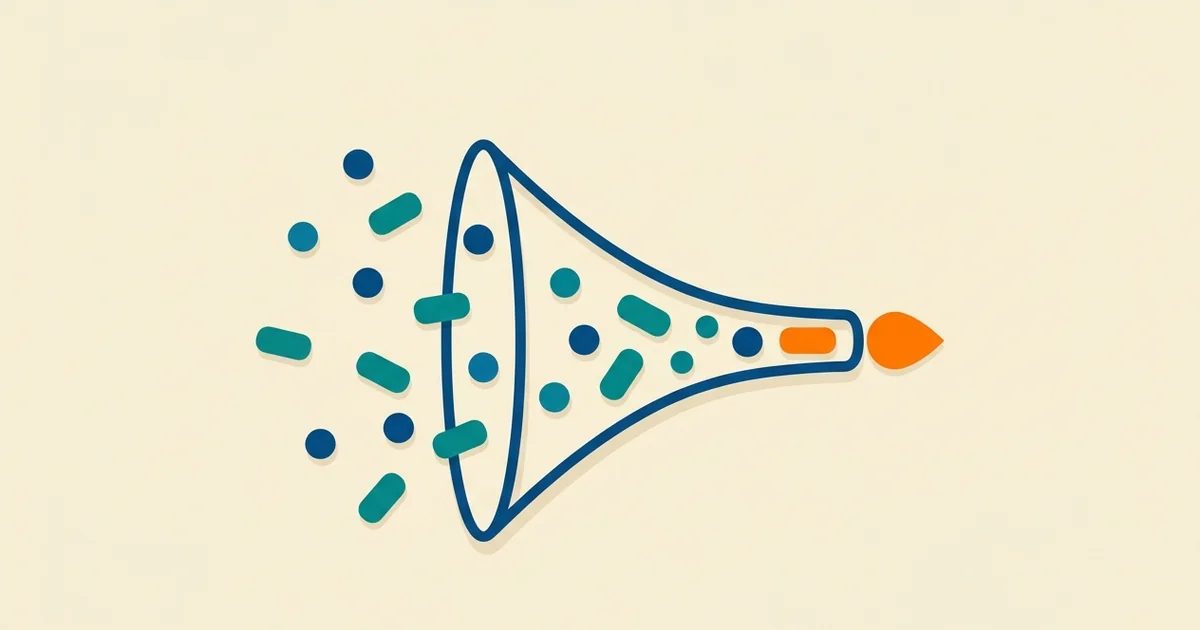
For more help at this stage, see funnel narrowing broad ideas into one research question.
How do you build an outline before drafting paragraphs?
Build an outline by assigning a job to every section before writing full paragraphs. A useful outline does more than list headings; it shows what each section must prove, explain, or prepare for the next section. This keeps the draft coherent from the beginning.
Move from sections to section purposes
A common student outline looks like this: introduction, literature review, methodology, findings, discussion, conclusion. That list is not wrong, but it does not tell you what to write. A better outline adds the function of each section.
For example, in a qualitative education paper about teachers’ perceptions of formative quiz apps, the literature review might not simply be “technology in education.” Its job could be: “Compare research on formative assessment, student engagement, and teacher workload to show why teacher perceptions matter.” That purpose gives you a filter for sources and paragraphs.
For a theoretical paper in law, the outline may not include a method section. A paper on proportionality in freedom of expression cases might move from doctrine, to competing interpretations, to application in selected cases, to an argued position. The outline must match the paper type.
Draft the outline as a chain of claims
Each section should pass something forward. The introduction defines the problem. The literature review shows what is known and where the tension lies. The method, if present, explains how evidence is collected or analysed. The findings or analysis present the evidence. The discussion explains what the evidence means.
A practical outline entry can use this format:
- Section title
- Section purpose
- Main claim or question
- Evidence needed
- Approximate word count
- Link to next section
For deeper outlining mechanics, see horizontal hierarchy of academic paper sections.
Avoid outline inflation
Outline inflation happens when headings fragment the argument. The appropriate number depends on the required format and the work each section does, not a universal word-count threshold.
A good test is the paragraph budget. If a section has only one short paragraph, ask whether it needs to be a separate heading. If a major section has 1,200 words in a 2,500-word paper, ask whether it is crowding out analysis, method, or discussion.
How do you move from sources to a literature review section?
Move from sources to a literature review by grouping studies around themes, debates, methods, or findings rather than summarising one source at a time. The literature review has to show how existing research connects to your question. Source notes become draft paragraphs only after you decide what role each source plays.
Read with a purpose
Reading without a question produces piles of notes. Reading with a question produces usable evidence. Before reading each source, ask: “What does this source help me explain, compare, challenge, define, or justify?”
Synthesis means relating sources to explain agreements, disagreements, patterns or limitations; it does not require a wholly novel claim. Summary means reporting what one source says. A literature review needs summary in small amounts, but its main work is synthesis.
For a nursing paper on medication adherence after discharge, one group of sources may explain patient-level barriers such as memory, cost, or side effects. Another group may address system-level issues such as discharge communication and follow-up. A third group may evaluate interventions such as pharmacist counselling or digital reminders. Those groups can become paragraphs or subsections.
Build source clusters before paragraphs
Instead of writing “Smith says…, Jones says…, Patel says…,” cluster sources by function:
- Background sources that define the problem
- Theory sources that provide concepts
- Empirical sources that report findings
- Method sources that justify your design
- Debate sources that show disagreement
- Gap sources that show what remains unresolved
A business paper on remote leadership might group sources around communication frequency, trust, employee engagement, and performance measurement. The literature review then becomes an argument about what the field already knows, not a reading diary.
If source credibility is uncertain, use a verification step before drafting. The article on reliable academic sources connected through DOI verification explains how to separate academic sources from weaker web material.
How do different research types change the research paper process?
Research approaches change the evidence, analysis and drafting tasks. Quantitative work can be descriptive or inferential. Qualitative analysis follows the chosen approach and need not produce themes. Existing datasets or documents can support empirical research; theoretical analysis and literature synthesis are distinguished by their purpose, not simply by avoiding new data collection.
Quantitative empirical papers
A quantitative empirical paper tests patterns, differences, or relationships using numerical data. The workflow focuses on variables, measurement, sampling, analysis, and results reporting.
For example, a psychology paper might ask whether passive Instagram use predicts anxiety scores among undergraduate students. The outline would need a method section explaining the sample, measures, procedure, and statistical test. The results section would report the test outcomes before the discussion interprets them.
Key workflow decisions include:
- Define the variables and measurements; assign predictor/outcome roles only where the question and design warrant them.
- Decide how each variable is measured.
- Choose analysis appropriate to the question and design; descriptive work does not necessarily need a significance test.
- Plan tables or figures before writing results.
- Interpret findings without overstating causality.
Qualitative empirical papers
A qualitative empirical paper examines meanings, experiences, perceptions, or practices. The workflow identifies participants or a corpus and explains the chosen approach to analysis; not every approach uses coding or produces themes.
In a nursing paper on older adults’ medication adherence after discharge, the research question may ask how patients describe barriers in home care. The method might use semi-structured interviews. In a thematic approach, findings would present interpretations developed from the actual evidence. Confusion about dosage or difficulty contacting providers are possible areas of interest, not predetermined findings.
Qualitative drafting needs careful movement from participant evidence to interpretation. Quotes do not speak for themselves. Each theme needs explanation, selected evidence, and a link back to the research question.
Theoretical, conceptual, and literature review papers
Theoretical and conceptual papers develop an argument using concepts, models, and existing scholarship. Literature review papers answer a research question by synthesising published research rather than collecting new primary data.
An education paper might ask how self-determination theory explains student engagement in online formative assessment. A law paper might evaluate whether a proportionality test balances public safety and freedom of expression in selected cases. A management paper might compare psychological safety and leader–member exchange as explanations for team learning.
These papers still need a workflow. The “method” may be a search strategy, selection logic, conceptual framework, or analytical lens rather than surveys or interviews.
What mistakes do students commonly make when moving from assignment to draft?
Students commonly lose control of a paper by starting too broadly, treating sources as decoration, or drafting before the research question is stable. These mistakes usually appear early but become visible only after several pages have been written. Fixing them requires going back to the workflow decision that was skipped.
Mistakes that create weak drafts
-
Writing a topic instead of a question
Student example: “My paper will discuss motivation and student achievement.”
Correction: Define the relationship, population, and context: “How do perceived teacher feedback practices relate to academic motivation among first-year university students?” -
Using a method that does not match the question
Student example: “I will interview five students to test whether online learning improves grades.”
Correction: Interviews can explore perceptions, but they cannot test grade improvement on their own. Reframe as a qualitative perceptions study or choose quantitative grade data. -
Adding sources after the argument is already written
Student example: “I wrote my views first and will find references that agree.”
Correction: Read before drafting the main argument so sources shape the claims, limits, and definitions. -
Choosing a population too large for the word count
Student example: “This paper examines healthcare workers worldwide during the pandemic.”
Correction: Narrow the setting, role, and issue: “Burnout risk factors among emergency nurses in hospital settings during the first year of the pandemic.” -
Treating the outline as a formatting task
Student example: “I have headings, so the structure is done.”
Correction: Add each section’s purpose, claim, evidence, and link to the next section.
Why these mistakes repeat
Most of these errors happen because students try to save time by skipping planning. The problem is that skipped planning usually returns as messy revision. A vague question creates a vague literature review. A broad topic creates shallow analysis. A weak outline creates paragraphs that do not connect.
The fix is not to spend weeks planning. The fix is to make the smallest necessary decisions before drafting: what the paper asks, what it will answer, what evidence it uses, and how each section contributes.
How do you revise the first draft before submission?
Revise the first draft by checking it against the assignment brief, research question, outline, evidence, citation rules, and paragraph structure. Editing grammar first is tempting, but structural problems need attention before sentence-level polishing. A quality report or revision checklist helps identify what to fix in the right order.
Start with the paper-level check
Read the draft once without editing sentences. Ask whether the paper answers the research question and fulfils the assignment brief. If the answer is unclear, mark the sections that drift from the task.
A paper-level check should ask:
- Does the introduction define the problem and lead to the question?
- Does the literature review synthesise sources rather than list them?
- Does the method or analytical approach fit the question?
- Does each section do the job promised by the outline?
- Does the discussion answer “so what?” rather than repeat findings?
- Does the conclusion return to the paper’s main claim?
Then check paragraphs and evidence
After the structure works, move to paragraph quality. Topic sentence means the sentence that states the paragraph’s main point. Evidence sentence means a sentence that supports the point with a source, example, data, or quotation. Analysis sentence means a sentence that explains why the evidence matters.
A paragraph that only describes sources will feel flat. A paragraph that makes claims without sources will feel unsupported. A good academic paragraph usually needs a claim, evidence, explanation, and connection to the question.
If paragraph structure is the main issue, see academic paragraph structure.
Before you move on: academic paper workflow checklist
- I have extracted the command verbs, limits, evidence rules, and formatting requirements from the assignment brief.
- My topic is narrow enough for the word count and deadline.
- My research question is answerable with the evidence I can access.
- My aim, objectives, and any hypotheses match the research question.
- My research type is clear: quantitative, qualitative, theoretical, conceptual, or literature review.
- My outline states the purpose of each major section.
- My literature review is organised by themes, debates, concepts, or methods.
- My sources are academic and relevant to the question.
- My first draft includes all required sections, even if they still need revision.
- My revision plan checks structure before grammar and formatting.
A first draft is successful when it gives you something coherent to improve. It does not need perfect wording, but it does need a visible line from brief to question, from question to evidence, and from evidence to answer.
For further reading, see UNC’s guide to understanding assignments and UNC’s strategies for reorganizing drafts. These are guidance for the reader, not evidence that an automated report performs every check.
Frequently Asked Questions
How long should an academic paper workflow take?
There is no universal number of sessions or weeks. Plan around the actual brief, reading, access and approval requirements, data or analysis needs, and time for feedback and revision. A draft may reveal decisions that need revisiting.
What is the difference between a paper workflow and an outline?
A paper workflow is the full process from assignment brief to first draft and revision. An outline is one stage inside that process. The workflow includes interpreting the brief, choosing the topic, developing the question, selecting sources or methods, drafting, and checking quality.
Can undergraduate students use the same workflow as master’s students?
Yes. Adapt the workflow to the actual brief, design and assessment criteria. Neither degree level alone nor a label such as “short paper” determines the required methodological care or evidence quality.
Should I write the introduction first or last?
You can draft a rough introduction early, but it often needs revision after the body is written. The introduction should match the final research question, scope, argument, and structure. Many students write a working introduction first, draft the main sections, then return to sharpen the opening.
How many sources do I need before writing a first draft?
You need enough sources to plan the argument responsibly, not necessarily every source you will cite in the final version. A short seminar paper may begin drafting with a small set of highly relevant sources. A longer research paper usually needs broader reading before the outline is stable.
Can an AI-powered writing service write the final paper for me?
A service may generate a complete model paper; Texio’s order includes payment, plan review and approval before drafting. That is different from permission to submit the generated paper as your own. Your course policy determines permitted assistance, attribution and disclosure, and you remain responsible for the final submission.